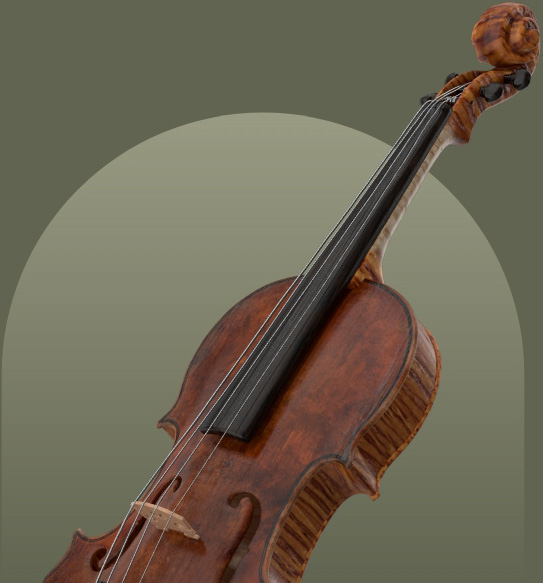
Italy School
David Tecchler
Rome, Rome .., Rome mid, c.1666–1747
David Tecchler (b. 1666, d. 1743) was a highly esteemed violin maker who transitioned from his early work in Salzburg, influenced by the German Stainer style, to become the most significant maker in Rome. Settling in Rome around 1705, he embraced the Italian pattern, achieving high perfection. His fine musical instruments, including violins, violoncellos, and double-basses, are noted for their powerful, pure, and sonorous tones, beautiful finish, and rich reddish-yellow varnish. While his thicknesses were sometimes imprecise, his use of excellent wood and adoption of the Italian style in Rome resulted in instruments that approach the quality of N. Amati.
Auction price history
Highest auction price
25 results
| Type | Details | Auction house | Sold | Price |
|---|---|---|---|---|
| Violin | 35.7 cm 1932 Probably by | — | June 2011 | £1,653 |
| Violin | 35.6 cm Rome, 1715 | — | March 2011 | £102,000 |
| Cello | 74.5 cm Rome, 1701 | — | October 2010 | £552,000 |
| Cello | 75.4 cm Rome, 1750 c. | — | April 2010 | £47,136 |
| Violin | 35.5 cm Rome, 1720 c. | — | April 2010 | £82,488 |
| Cello | 77.2 cm Rome, 1730 c. (later Italian scroll) | — | October 2009 | £324,000 |
| Violin | 35.3 cm 18th C. Attributed to | — | March 2009 | £11,250 |
| Violin | 1800 c. Attributed to | — | November 2005 | £4,800 |
| Cello | Rome, 1703 (bass rib replaced) | — | November 2005 | £152,770 |
| Violin | Rome, 17.. | — | June 2005 | £22,540 |
| Violin | mid-18th C. Ascribed to | — | May 2005 | £14,400 |
| Violin | Rome, mid-19th C. Attributed to | — | May 2004 | £2,573 |
| Violin | Rome, 1709 | — | March 2004 | £47,800 |
| Violin | 1710 | — | June 2001 | £29,900 |
| Cello | 1717 | — | November 2000 | £170,423 |
| Violin | 1705 | — | October 1998 | £13,800 |
| Violin | 1705 | — | October 1997 | £17,250 |
| Violin | 1722 | — | March 1997 | £18,975 |
| Violin | 17-- | — | June 1994 | £49,900 |
| Violin | 1720 c. | — | November 1992 | £30,800 |
| Violin | 1741 | — | November 1992 | £41,800 |
| Cello | 1723 | — | November 1991 | £187,000 |
| Violin | 17-- | — | March 1990 | £16,500 |
| Cello | 1706 | — | March 1989 | £60,500 |
| Violin | 1711 | — | April 1987 | £22,000 |
No results match those filters.
Maker Overview
Life
David Tecchler (b. 1666, d. 1743) began his career in Salzburg before moving to Venice. Owing to ill-treatment from local makers there, he left Venice and finally settled in Rome about 1705. It is said he stopped at Cremona on his way to Rome. Little is known of his life; it is recounted that he was greatly antagonized by the local violin makers in Venice, which led to his relocation to Rome, where he is said to have been for a time enlisted in the Pope's Swiss Guard. Tecchler primarily worked in Rome, though he also spent time in Salzburg and Venice. His labels include "David Tecchler Liutaro fecit Romae, anno 1703," a similar one dated 1706, "David Tecchler fecit Romae, 1733," and "David Techler fecit, an. Dni. 1743, aetatis suae, 77." The name also appears as Techler, Tekler, Deckler, or Dechler.
Characteristics
- Materials
- Tecchler selected excellent wood for his string musical instruments.The bellies of his instruments often feature a mottled character, similar to the wood frequently used by Niccolo Amati.
- Methods
- Tecchler's earliest violins, probably made in Salzburg, unmistakably show the Stainer style, characterized by being high-modelled with sound-holes partaking of the Stainer character. Instruments dated from Rome generally exhibit fine workmanship, closely following the Italian pattern, and are finely formed. His violoncellos are especially good, made on a large pattern and much arched, though their thicknesses were often not precisely calculated. Characteristic features of his work include elongated corners and large F-holes, which vary and are sometimes widely opened. His varnish is of good quality, generally reddish-yellow, sometimes yellow-brown, or a rich yellow tint. His work is beautifully finished, demonstrating highly finished workmanship.
- David Tecchler Liutaro
fecit Romae Anno 1703John Dilworth - David Tecchler
Fecit Rome, Anno Dn 1722John Dilworth - David Dechler fecit Rom. 1710John Dilworth
- David Techler fecit an Dn 1743
la mia terza viola e aetatis suae 77John Dilworth
Influence and legacy
- Schools/Tradition: Tecchler's early violins made in Salzburg clearly show the Stainer style. After moving to Rome around 1705, he aligned himself more with the Italians, achieving his highest perfection there. He is considered the most significant violin maker in Rome, coming very close to the quality of N. Amati.
- Notable Associations: His Salzburg instruments were probably made to the order of his patrons. It is also recounted that he was briefly enlisted in the Pope's Swiss Guard in Rome.
- Modern Recognition: David Tecchler is a highly esteemed maker, considered the most significant violin maker in Rome. His fine musical instruments are recognized for their quality.
Biographies
The overview above is drawn from the following published accounts. Read them in the original:
John Dilworth+
TECCHLER, David Born circa. 1666 Lechbruck, Füssen Germany, d.c.1747 Rome Italy. The Tecchler family in Füssen were neighbours of the Socher family: Giovanni and Giacomo Socher were recorded as luthiers in Rome c.1650. David Tecchler was himself active in Rome from 1696 where he was probably apprenticed to Alberto Platner. Established from 1698 in the parish of S. Lorenzo in Damaso. From 1699-1711 he was living near the Biagio della Fossa, whilst keeping a separate workshop at 16 Via dei Leutari up until 1703. In 1720 he is found in a different parish, that of SS. Celso e Giuliano, and in 1730 he moved again but within the same parish. The earliest known work is a cello with a manuscript label of 1697, a pochette of 1698, and a violin dated 1699. Tecchler’s violins are in the dominant Stainer style of the period. The violins are very sophisticated, the arching not exaggerated, and the details conscientiously handled. The soundholes are rather Amatisé, with softly rounded nicks set very low on the table giving an awkwardly long stop length. The varnish is of excellent quality; pale golden colour later darkening to shades of red-brown. The scroll is very Germanic with a tendency towards an extended last turn; very well poised and neatly finished. Rather narrow across the eyes and slightly cramped in appearance from front or back. Locating pins are invariably placed at the ends of the plates within the purfling boundary. Beech wood is extensively used for the purfling and interior. Tecchler’s cellos are his most significant work. He famously admitted on the label of one viola of 1743 that it was only the third such instrument he had made. But his cellos are magnificent and frequently encountered. Built on large proportions (many have since been cut down) they have an impressively full arching to match, although with a deep and narrow channel all around the edge. The soundholes are usually set upright and widely spaced and are very elegantly cut. The fronts are generally of good straight spruce. The backs and sides are often of dark coloured ‘oppio’ maple with characteristic small interlocking rippled figure. The varnish is deep orange-brown, generally quite closely integrated to the surface of the wood and often highly crackled, contributing to the magnificently rich appearance of these instruments. The National Museum of Rome also has a charming mandolin dated 1726. David Tecchler Liutaro / fecit Romae Anno 1703 David Tecchler / Fecit Rome, Anno Dn 1722 David Dechler fecit Rom. 1710 David Techler fecit an Dn 1743 / la mia terza viola e aetatis suae 77 [Lebet, Bletschacher]
Cecie Stainer+
b. 1666. Lived first at Salzburg, then went to Venice, but owing to the ill-treatment he received from the makers there, left Venice and finally settled in Rome about 1705; he is said to have stopped at Cremona on his way there. Some of his work is very German in character, but instruments dated from Rome are generally of fine workmanship, and follow the Italian pattern very closely. His violoncellos are especially good ; made of excellent wood, on a large pattern, much arched, but the thicknesses are often inaccurate ; the sound-holes are large, they vary, sometimes being widely opened, sometimes not ; the varnish, of good quality, is generally reddish-yellow, sometimes yellow-brown in colour ; the tone is very powerful, the work beautifully finished ; one was sold at an auction for ;£50. His double-basses also show good work and have a sonorous tone. A violin of highly finished workmanship was made of beautiful wood and had a very pure and sweet tone. Labels : ” David Tecchler Liutaro fecit Romae, anno 1703,” a similar one is dated 1706: “David Tecchler fecit Romae, 1733.” and ” David Techler fecit, an. Dni. 1743, aetatis suae, 77.”
George Hart+
A highly esteemed maker. He worked in Venice, Salzburg, and Rome, chiefly in the latter city. His instruments vary in form, some having a marked German style: they are high-modelled, and the sound-hole partakes of the Stainer character. These were probably made in Salzburg to the order of his patrons. Those instruments which date from Rome are chiefly of the Italian type, and are so much superior to the others that it seems difficult to reconcile varieties so distinct as the work of the same man. They are finely formed, have splendid wood, and rich varnish of a yellow tint; the bellies are of a mottled character, similar to those so much used by Niccolo Amati. His Violoncellos are among the finest of his instruments. They are mostly of a large size.
Willibald Leo Lütgendorff+
Der Name kommt auch Techler, Tekler, Deckler, Dechler u. s. w. geschrieben vor. Seine ältesten, wahrscheinlich noch in Salzburg gemachten Geigen zeigen unverkennbar den Stainer’schen Stil. Um 1705 nach Rom gegangen, schliesst er sich mehr den Italienern an und erreicht hier seine höchste Vollendung. Er ist der bedeutendste Geigenmacher Roms, kommt N. Amati sehr nahe und zeichnet sich sowohl durch prachtvolle Arbeit als auch durch die Tonfülle seiner Geigen aus. Er wählte meist grosse Modelle, nahm wundervolles Holz, das er freilich in der Dicke nicht allzu genau berechnete, und besass einen reichen Lack von gelbröthlicher Farbe. Charakteristisch für ihn ist die Verlängerung der Ecken und die breiten, oft zu weit geöffneten F-Löcher. Ausser Violinen machte er auch hervorragend schöne Violoncelli und Bässe, die allerdings sehr breit ausfielen. Von seinem Leben ist wenig bekannt, es wird nur erzählt, dass er in Venedig von den einheimischen Geigenmachern sehr angefeindet wurde und desshalb nach Rom übersiedelte, wo er u. A. eine Zeit lang in die Schweizer Garde des Papstes eingereiht gewesen sein soll.
Henri Poidras+
The best master of the Roman School. His instruments made at Rome are very fine and bear a thorough Italian character: others, very arched, are of the German style and have much less value. This maker, who also worked at Venice, seems to have specialized in the making of ‘cellos of a large pattern. He was still working in Salzburg at the beginning of the XVIIth century. Both model and varnish are fine, the latter being yellow verging on red. The corners are a little long. Violins and ‘cellos by this master are sought after by artists for their powerful tone. The sound holes, rather short, betray his German origin.
Karel Jalovec+
Venice, Rome. Born about 1666, died 1743. — Built instruments on the large pattern of Amati, the arching is made, however, in the fashion of Stainer. The corners are elongated in a characteristic way, the scrolls gracefully carved: the rather broad purfling is well finished; the small, adequately open soundholes are designed according to Stainer. He selected wood of fine appearance, applied a wonderful yellow or yellow-red varnish of excellent quality; the ‘cellos are red-brown or dark red. His broad contrabasses are likewise very good. He was an assiduous master and left a considerable number of instruments. Singular is a viola which is rather broad, with the arching of the belly spreading in a graceful manner over the whole surface of the plate, the sides glued to the very edges of the tables (as it is usual in contrabasses), the short sound-holes gracefully rounded off, while the back is flat, without arching, made up of 9 strips like that of a guitar. This instrument does not sound like a viola, but has a deep bass tone. Price of violins 50— 80.000 Kc. a ‘cello far more.
Sell your instrument with Amati
Get started by uploading photos of your instrument for our experts to review.
Sell your instrument with Amati
Get started by uploading photos of your instrument for our experts to review.