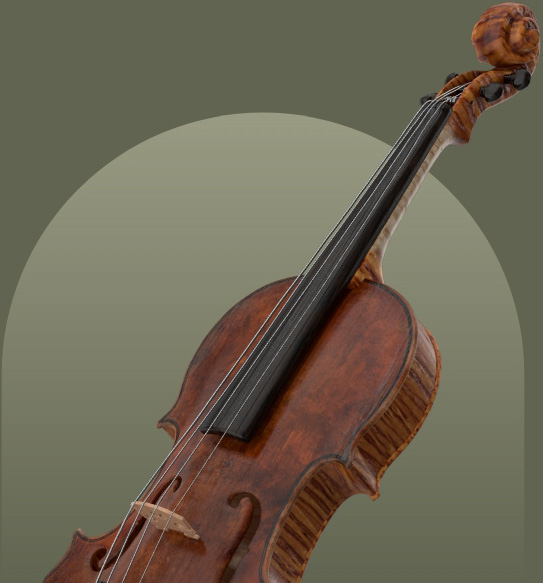
Leopoldo il Tedesco (Todesco)
c.1625–1660
Leopoldo il TEDESCO (TODESCO) (born 1625, died c.1660) was a German luthier who apprenticed with Nicolò Amati in Cremona from 1652 to 1654. He subsequently established his own workshop in Rome, where he produced instruments inspired by Amati's model. While his workmanship was often considered less refined than his master's, his varnish was frequently praised for its quality.
Maker Overview
Life
Leopoldo il TEDESCO (TODESCO) (born 1625, died c.1660) was born in Germany, and his name, meaning 'the German', suggests his origin.
Characteristics
- Model
- He made good instruments inspired by Amati's model, working on Amati's pattern, though Karel Jalovec notes he fell short of his master's art. John Dilworth describes his work as basically of Amatisé form.
- Workmanship
- Henri Poidras states that his workmanship is not of the first order. Willibald Leo Lütgendorff notes that he was not particularly clean in execution. John Dilworth describes his work as weak and poorly finished.
- Varnish
- His varnish is compensatingly fine, and has praiseworthy properties. Cecie Stainer. mentions he had good varnish, while John Dilworth describes it as a thin yellow-brown varnish.
- Leopoldo il Tedesco
alievo di Amatis Cremonae
fecit Romae 1659John Dilworth
Influence and legacy
- Mentorship: He was a pupil of Nicolo Amati in Cremona from 1652 to 1654, as confirmed by Karel Jalovec, John Dilworth, Willibald Leo Lütgendorff, and Cecie Stainer.
- Inspiration: He made instruments inspired by Amati's model and worked on Amati's pattern.
- Notable Instruments: A violin by him was listed in Bruni's inventory (page 5), belonging to Marquis Chabert de Cogolin (died 1805).
Biographies
The overview above is drawn from the following published accounts. Read them in the original:
John Dilworth+
TEDESCO (TODESCO), Leopoldo il Born 1625 Germany, d.c.1660 Rome Italy. Recorded on the Cremona census returns as an apprentice of Nicolò Amati 1652-1654. His name, meaning ‘the German’, suggests his origin. Subsequently established in Rome. One of the few foreign assistants of Amati to work independently. His work is not as impressive as his pedigree. Although basically of Amatisé form, it is weak and poorly finished with a thin yellow-brown varnish. Leopoldo il Tedesco / alievo di Amatis Cremonae / fecit Romae 1659
Cecie Stainer+
b. 1625. Was a pupil of Nicola Amati in Cremona, 1653-54. Afterwards worked in Rome ; a violin dated from there in 1658 is made on the Amati pattern, and has good varnish, but the work is not highly finished.
Willibald Leo Lütgendorff+
Von 1652—1654 arbeitete er in Cremona bei Nic. Amati. Dann ging er nach Rom, wo er noch 1658 vorkommt. Er arbeitet nach dem Amati-Modell, ist aber nicht besonders sauber in der Ausführung, dagegen hat sein Lack lobenswerthe Eigenschaften. In Bruni’s Inventar (S. 5) wird eine Violine von ihm aus dem Besitze des Marquis Chabert de Cogolin († 1805) aufgeführt, deren Zettel Bruni sichtlich nicht lesen konnte; er las: »Leopoldo per rebere tedesco alievo di Nicolas Amatis Cremone 1750«. Abgesehen von der falschen Jahreszahl und Schreibfehlern ist das unverständliche »per rebere« — wenn es nicht »peregre (d. h. in der Fremde) geheissen —, vielleicht der eigentliche Familienname oder die Heimathsbezeichnung gewesen, da »il Tedesco« doch nur ein Beiname war.
Henri Poidras+
After having worked in Amati’s workshops, this maker left and established himself at Rome where he made good instruments inspired by the master’s model. If his workmanship is not of the first order, his varnish is compensatingly fine.
Karel Jalovec+
Rome. Born about 1625, no works after 1658. Pupil of Nicolo Amati, worked on Amati’s pattern but fell short of his master’s art. Price 20.000 Kc.
Sell your instrument with Amati
Get started by uploading photos of your instrument for our experts to review.
Sell your instrument with Amati
Get started by uploading photos of your instrument for our experts to review.