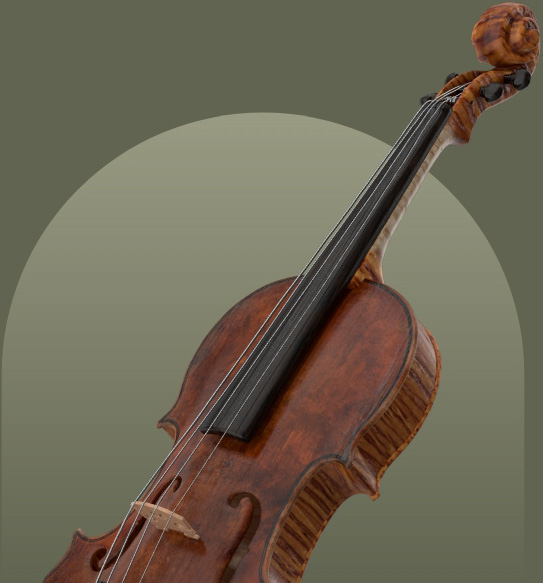
Richard Tobin
London, 1766–1847
Apprenticed to Thomas Perry in Dublin 1792-1798. Worked briefly for Bartholomew Murphy in Cork. One instrument bearing his label gives Waterford as his residence in 1800. Moved to London; said to have been on the advice of V. Panormo who had earlier worked for Perry. Earliest London work is dated 18\u{2026} — John Dilworth
Auction Price History
Highest auction price
14 results
| Type | Details | Auction house | Sold | Price |
|---|---|---|---|---|
| Viola | Labelled Richard Tobin London 1820 Lot 102 | Ingles & H. | March 2024 | £16,800est. £ 10,000-15,000 |
| Violin | 35.6 cm London, 1800 c. | — | March 2009 | £3,840 |
| Violin | 35.5 cm London, 1840 c. | — | March 2008 | £9,375 |
| Viola | 38.7 cm London, 1820 c. | — | October 2007 | £2,877 |
| Violin | 1800 c. | — | July 2003 | £5,875 |
| Viola | 38.4 cm 1810 | — | March 2001 | £3,162 |
| Violin | 1820 | — | March 1999 | £8,280 |
| Violin | 1820 c. | — | June 1991 | £4,400 |
| Violin | 18-- | — | April 1991 | £770 |
| Violin | 1840 c. | — | April 1991 | £7,920 |
| Viola | 38.9 cm 1810 c. | — | March 1991 | £2,860 |
| Cello | 1800-15 | — | March 1990 | £13,750 |
| Violin | 1800-50 | — | November 1984 | £1,026 |
| Violin | 1829 | — | July 1984 | £3,520 |
No results match those filters.
Maker Overview
Life
Richard Tobin (1766-1847) was born in 1766 in the Republic of Ireland and died in 1847 in London, UK. He was apprenticed to Thomas Perry in Dublin from 1792 to 1798. He also worked briefly for Bartholomew Murphy in Cork. One instrument bearing his label indicates Waterford as his residence in 1800. He moved to London, reportedly on the advice of V. Panormo, who had previously worked for Perry. His earliest London work is dated 1810 and appears to have been made under the aegis of Lockey Hill. A violin dated 1817 is internally signed 'R. Tobin for L. Hill'. He established himself in St Leonard Street, Finsbury Square, and from 1823, in his own premises at 9 West Street, Soho., he was born a few miles outside Dublin and developed a love for the fiddle in childhood, making instruments from various materials. At fourteen, he made a violin from a willow block, which he sold to a fiddler who brought it to Perry and Wilkinson. Old Perry, impressed by his workmanship, invited him to learn violin-making, an invitation Tobin accepted. He remained with the Dublin firm for a number of years, becoming a very clever workman and making the majority of the instruments that brought fame to Perry & Wilkinson. Later he moved to London and worked for "old" Betts until Betts' death in 1823. Tobin was described as eccentric and intemperate, often trying Betts' patience. He would save money, remain sober for a few months, then embark on a two or three-week carouse, spending all his savings. When working, he was busy and incommunicative. He died in great poverty in Shoreditch.
Characteristics
- Workmanship
- Richard Tobin produced very accurate and finely finished work in classical Italian styles. He was an excellent workman.
- Scroll Carving
- He had the reputation of being the finest scroll carver in London in his time, and his hand can be recognized on many instruments with the shop labels of Betts, Dodd, and Gilkes. William Meredith Morris states that he would finish a scroll within two hours, and his scrolls are superb, never bettered by Antonio Stradivari.
- Patterns
- He usually followed the Stradivari or Guarneri patterns, exclusively imitating them.
- Tone
- The tone of his instruments is good, and they are much liked in England. His violoncellos are considered among the best made in England.
- Labeling & Signing
- Instruments are often signed internally on the table and sometimes branded below the back button. Authentic labels are extremely rare.
Influence and legacy
- Apprenticeship: Richard Tobin was apprenticed to Thomas Perry in Dublin from 1792 to 1798.
- Early Employment: He worked briefly for Bartholomew Murphy in Cork.
- Mentorship & Collaboration: He worked under the aegis of Lockey Hill, as evidenced by a violin dated 1817 signed 'R. Tobin for L. Hill'. He did a great deal of work for John Betts, and his hand can be recognized on instruments with the shop labels of Betts, Dodd, and Gilkes.
- Advisory: His move to London is said to have been on the advice of V. Panormo.
- Reputation: His instruments are much appreciated by the best judges and are much liked in England.
- Family Continuity: A son of his was also a maker.
- Poverty: Despite his skill, he died in great poverty in Shoreditch.
- Rarity of Labeled Instruments: Few instruments bear his own label; William Meredith Morris states he had seen no more than two, and does not think there are a dozen in existence.
Biographies
The overview above is drawn from the following published accounts. Read them in the original:
John Dilworth+
TOBIN, Richard Born 1766 Republic of Ireland, died 1847 London UK. Apprenticed to Thomas Perry in Dublin 1792-1798. Worked briefly for Bartholomew Murphy in Cork. One instrument bearing his label gives Waterford as his residence in 1800. Moved to London; said to have been on the advice of V. Panormo who had earlier worked for Perry. Earliest London work is dated 1810 and appears to have been made under the aegis of Lockey Hill. A violin dated 1817 is signed ‘R. Tobin for L. Hill’ internally. Established in St Leonard Street, Finsbury Square, and from 1823 in his own premises at 9 West Street, Soho. Very accurate and finely finished work in classical Italian styles. He has the reputation of being the finest scroll carver in London in his time, and his hand can be recognised on many instruments with the shop label of Betts, Dodd, and Gilkes. Instruments often signed internally on the table; sometimes branded below back button. Authentic labels extremely rare. [BVMA]
Cecie Stainer+
A maker in London from about 1790 to 1840. Was a pupil of Perry of Dublin. He did a good deal of work for John Betts. He was an excellent workman, and cut most beautiful heads or scrolls to his instruments ; he usually followed the Stradivari or Guarneri patterns. The tone of his instruments is good, and they are much liked in England. He died in great poverty in Shoreditch. A son of his was also a maker.
William Meredith Morris+
According to his own account he was born a few miles out of Dublin. His love for the fiddle dated back to early childhood, when he often heard its strains at merry-makings, wakes, &c. As a lad he was fond of making fiddles out of all sorts of boxes, &c. At the age of fourteen he made a fairly good instrument out of a willow block. This he sold to a neighbouring fiddler, who shortly after brought it to Perry and Wilkinson. Old Perry was struck with the workmanship of the embryo fiddle-maker, and sent word that he would teach him violin-making if he came to him. Needless to say, young Tobin accepted the invitation. This was about 1802, and Tobin remained with the Dublin firm eleven years. He soon became a very clever workman, and he made the majority of these magnificent instruments which brought fame and money to the house of Perry & Wilkinson. In 1813 he came to London, and found his way to the workshop of “old” Betts, who was quick to discover his abilities, and employed him till his (Betts’) death in 1823. Tobin was eccentric and intemperate, and often tried the temper of Betts to the breaking point. When he had saved up a little money and kept sober for perhaps three months at a stretch, the mania for drink would break out afresh, and he would go off on a fortnight or three weeks’ carouse, till he had spent all his savings. When at work he was busy and of a most incommunicative turn of mind. He worked very fast, and would finish a scroll inside of two hours. The few instruments which bear his label are exceedingly handsome copies of Stradivari or Guarnerius, and they have a rich and mellow tone. The best instruments of the Dublin firm were made by him, as were also many of the choicest violins which bear the label of Betts. I do not think there are a dozen violins in existence which bear the label of Tobin himself, and I have not seen more than two. His scrolls are superb ; never did Antonio Stradivari cut better, as the accompanying illustration will testify.
George Hart+
Pupil of Perry, of Dublin. His instruments are much appreciated by the best judges. In cutting a scroll he was unequalled amongst English makers.
Willibald Leo Lütgendorff+
Er war in Dublin geboren und war ein Schüler von Perry. Da er viel für John Betts arbeitete, kommen nur wenige Geigen mit seinem Zettel vor. Er besass eine ausserordentliche Handgeschicklichkeit und erkannte auch frühzeitig die Vorzüge der Stradivari- und Guarneri-Modelle, die er ausschliesslich nachahmte. Besonders schön sind seine Schnecken ausgeführt; auch im Ton sind seine Geigen sehr gut, und seine Violoncelli gehören zu den besten, die in England gemacht wurden. Trotzdem starb er in grösster Armuth.
Henri Poidras+
London circa 1800. Father and son. Good make. Stradivarius model. Has worked for J. Betts.
Sell your instrument with Amati
Get started by uploading photos of your instrument for our experts to review.
Sell your instrument with Amati
Get started by uploading photos of your instrument for our experts to review.