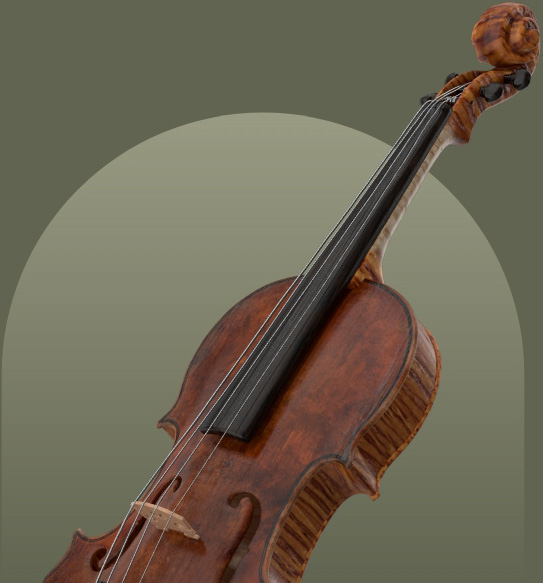
Crescenzio Ugar
d. 1791
Crescenzio Ugar was an 18th-century violin maker born in Urbino, active in Rome, Italy, where he died in 1791. Of probable German origin, his instruments are noted for their German character, unrefined finish, but good Italian proportion and balance. He used second-quality materials and a golden- to red-brown or brown varnish. His double basses were particularly admired. Sources conflict on his birth year (before 1751 or 1712) and his relationship with Giuseppe Orselli, who is described as either his teacher or his pupil and inheritor of his workshop.
Auction price history
Highest auction price
| Type | Details | Sold | Price |
|---|---|---|---|
| Violin | 1785 | November 1986 | £8,800 |
Maker Overview
Life
Crescenzio Ugar (before 1751-1791) was born in Urbino, the son of Carlo Ugar of Urbino. Sources contain conflicting information regarding Crescenzio Ugar's birth year; John Dilworth states he was born before 1751 in Urbino, while Karel Jalovec indicates a birth year of 1712 in Urbino. He died in 1791 in Rome, Italy. He was probably of German origin, and his work is often described as having a German character or style. Ugar was first noted in the Roman archives as a violin maker in SS. Sudario dalla parte de' Barbieri in 1788. In his will of 1791, several unfinished violins, cellos, and basses were listed amongst the tools and equipment of his workshop.
Characteristics
- Workmanship
- Instruments produced by Crescenzio Ugar are characterized by an unrefined finish but possess good Italian proportion and balance. Henri Poidras described his work as 'Ordinary work,' and Karel Jalovec noted his instruments were of medium quality.
- Design Elements
- His instruments feature long soundholes with emphatically cut nicks, a medium arch, and a narrow edge. The head is distinctive, with a long, slender pegbox and a quite concentric scroll featuring a deeply extended final turn. Some instruments are noted to have whalebone purfling.
- Materials
- Ugar utilized materials of second quality, including heavy-grained fronts and often flawed maple of apparently local origin.
- Varnish
- He used a good but not exceptional varnish of golden- to red-brown. Other sources, including Cecie Stainer, Henri Poidras, and Karel Jalovec, describe his varnish as brown or brown of plain appearance.
- Admired Instruments
- His double basses were much admired.
- Label
- A label in a double bass cited by Strocchi reads: 'Crescentius Ugar / fecit Romae anno 1788 [Lebet]'.
- Label in double bass cited by Strocchi: Crescentius Ugar
fecit Romae anno 1788John Dilworth
Influence and legacy
- Mentorship: Sources contain conflicting information regarding Crescenzio Ugar's relationship with Giuseppe Orselli. Karel Jalovec states that Ugar was a pupil of Giuseppe Orzelli, while John Dilworth notes that Ugar's will of 1791 listed workshop contents left to his pupil Giuseppe Orselli.
- Style: His work is described as German in character or style by Cecie Stainer, Henri Poidras, and Willibald Leo Lütgendorff, with Karel Jalovec stating he 'Worked in the fashion of the German school.'
- Workshop Succession: In his will of 1791, Crescenzio Ugar left the tools and equipment of his workshop, along with several unfinished instruments, to his pupil Giuseppe Orselli.
Biographies
The overview above is drawn from the following published accounts. Read them in the original:
John Dilworth+
UGAR, Crescenzio Born before 1751 Urbino, died 1791 Rome Italy. Son of one Carlo Ugar of Urbino. Probably of German origin. First noted in the Roman archives as a violin maker in SS. Sudario dalla parte de’ Barbieri in 1788. Fine instruments of unrefined finish but good Italian proportion and balance. Long soundholes with emphatically cut nicks. Medium arch and narrow edge. Distinctive head with long slender pegbox and quite concentric scroll with deeply extended final turn. Some instruments noted with whalebone purfling. Good but not exceptional varnish of golden- to red-brown. Materials of second quality, heavy-grained fronts and often flawed maple of apparently local origin. Double basses much admired. In his will of 1791 several unfinished violins cellos and basses are listed amongst the tools and equipment of the workshop left to his pupil Giuseppe Orselli. Label in double bass cited by Strocchi: Crescentius Ugar / fecit Romae anno 1788 [Lebet]
Cecie Stainer+
A maker in Rome in 1790 His work is German in character, he used brown varnish.
Willibald Leo Lütgendorff+
Wahrscheinlich ein Deutscher, der vielleicht Ungar oder Unger hiess. Seine Arbeit hat ein deutsches Aussehen, ebenso sein brauner Lack.
Henri Poidras+
Ordinary work. Brown varnish. German style.
Karel Jalovec+
b. in Urbino 1712, d. in Rome 1791, pupil of Giuseppe Orzelli. Few specimens are known. Worked in the fashion of the German school. Instruments of medium quality. He used a brown varnish of plain appearance. Price 10.000 Kc.
Sell your instrument with Amati
Get started by uploading photos of your instrument for our experts to review.
Sell your instrument with Amati
Get started by uploading photos of your instrument for our experts to review.