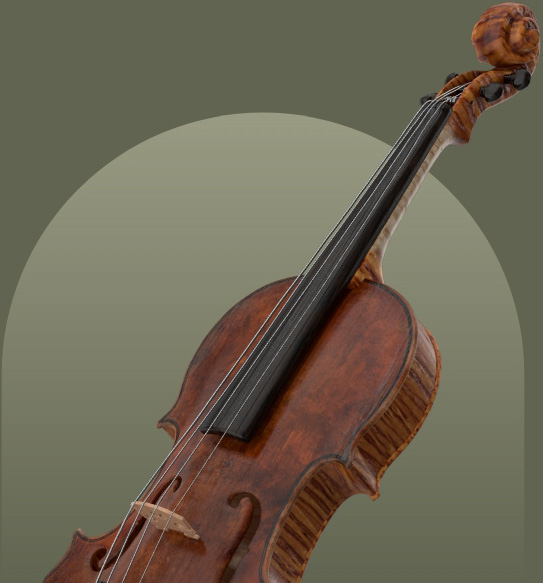
Ellwangen School
Benedikt Wagner
Ellwangen, 1720–1796
Benedikt Wagner (1720-1796) was a highly regarded luthier from Ellwangen, Germany, known for his precise and praiseworthy work, often following the Stainer model. He served as the luthier for the Prince-Provost of Ellwangen. His instruments are characterized by medium to high arching, a narrow edge with fine purfling, and a distinctive Germanic scroll. Wagner's varnish ranged from transparent golden-brown to red, and his violins, particularly those with flatter arching, were noted for their bright and brilliant tone. He utilized both paper labels and brand marks, including 'Wagner' on the back and 'Elwang' on the lower rib.
Auction price history
Highest auction price
| Type | Details | Sold | Price |
|---|---|---|---|
| Violin | 36.2 cm Ellwangen, 1779 | April 2010 | £1,611 |
| Cello | Ellwangen, 1788 Child's size | October 2005 | £1,629 |
Maker Overview
Life
Benedikt Wagner (1720-1796) was born in 1720 and died in 1796 in Ellwangen, Germany., some sources indicate that he worked around 1750 in Dürrwangen. He was a skilled master who served as the luthier for the Prince-Provost of Ellwangen, who found a label from 1769 identifying him as "Benedict Wagner hochfürstlichen Hof Lauten und Geigenmacher in Ellwangen."
Characteristics
- Workmanship
- Benedikt Wagner produced very precise and praiseworthy work, often on the Stainer model, and is considered by John Dilworth to be probably the best maker of his family. Cecie Stainer described his workmanship as fair.
- Archings and Models
- His instruments typically featured arching of medium height. Willibald Leo Lütgendorff noted that his violins usually had high arching and were large, but he also appeared to have known Italian models, after which he made instruments with flat arching and delicate execution. Lütgendorff further distinguished three different models, with one having flat arching and a longer body, similar to those by Buchstädter. Henri Poidras also mentioned his arched violins and large patterns.
- Edges and Purfling
- John Dilworth described a narrow edge with finely laid purfling extending to the very end of the corners.
- Scroll
- The scroll was very Germanic in style, featuring a short, goose-necked pegbox and a well-turned volute extended with a curving gouge cut up into the eye, as detailed by John Dilworth. Willibald Leo Lütgendorff added that the scroll was often robust but always original.
- Varnish
- His varnish was particularly well-textured and transparent golden-brown. Cecie Stainer observed red varnish. Willibald Leo Lütgendorff noted his varnish could be yellow-brown, dark brown, or red. Henri Poidras also mentioned red or yellow-brown varnish.
- Tone
- The tone of his instruments, especially the flatter-arched violins, was bright and brilliant. Henri Poidras described a powerful tone.
- Branding
- He branded his instruments below the back button with a reverse stamp (raised letters) reading 'Wagner' and below the endpin on the lower rib with 'Elwang'. Willibald Leo Lütgendorff confirmed the use of brand marks, stating that the name 'Wagner' was branded on the back near the neck plate, and the place name 'Ellwang' was branded on the ribs under the tailpiece button.
- Branded below endpin on lower rib: ‘Elwang’ Benedict Wagner, Hochfürstlicher
Hof Lauten und Geigenmacher
in Ellwangen. anno 1772John Dilworth
Biographies
The overview above is drawn from the following published accounts. Read them in the original:
John Dilworth+
WAGNER, Benedikt Born 1720, died 1796 Ellwangen Germany. Some sources indicate that he worked c.1750 in Dürrwangen. Very precise and praiseworthy work on the Stainer model. Probably the best maker of this family. Arching of medium height. Narrow edge with finely laid purfling extending to the very end of the corners. Scroll very Germanic in style; short goose-necked pegbox and well turned volute extended with a curving gouge cut up into the eye. Varnish particularly well-textured and transparent golden-brown. Branded below back button with reverse stamp (raised letters): ‘Wagner’ . Branded below endpin on lower rib: ‘Elwang’ Benedict Wagner, Hochfürstlicher / Hof Lauten und Geigenmacher / in Ellwangen. anno 1772 [Hamma]
Cecie Stainer+
A maker of lutes and violins in Ellwangen in 1769, according to a label found in a violin, much arched, with red varnish, of fair workmanship. Label: “Benedict Wagner hochfürstlichen Hof Lauten und Geigenmacher in Ellwangen, anno 1769.”
Willibald Leo Lütgendorff+
Ein tüchtiger Meister, der im Dienste des gefürsteten Propstes von Ellwangen stand. Seine Geigen haben meist hohe Wölbung und sind gross, doch scheint er auch italienische Vorbilder gekannt zu haben, nach denen er flache und zierlich durchgeführte Instrumente machte. Sein Lack ist gelbbraun, dunkelbraun oder roth, der Ton, namentlich bei den flachgewölbten Geigen, hell und glänzend. Ausser seinem Zettel verwendete er auch Brandmarken; den Namen »Wagner« brannte er auf dem Boden nächst der Halsplatte ein, auf den Zargen unter dem Saitenhalterknopf die Ortsbezeichnung »Ellwang«. Man unterscheidet bei ihm drei verschiedene Modelle, zwei davon beschreibt Piegendorfer in seiner trefflichen kleinen Schrift über die schwäbischen Geigenmacher, das dritte hat flache Wölbung und einen längeren Korpus (ähnlich wie Buchstädter). Die Schnecke ist oft derbkräftig, aber immer originell.
Henri Poidras+
Ellwangen circa 1765. Arched violins. Red or yellow-brown varnish. Large pattern. Powerful tone.
Sell your instrument with Amati
Get started by uploading photos of your instrument for our experts to review.
Sell your instrument with Amati
Get started by uploading photos of your instrument for our experts to review.