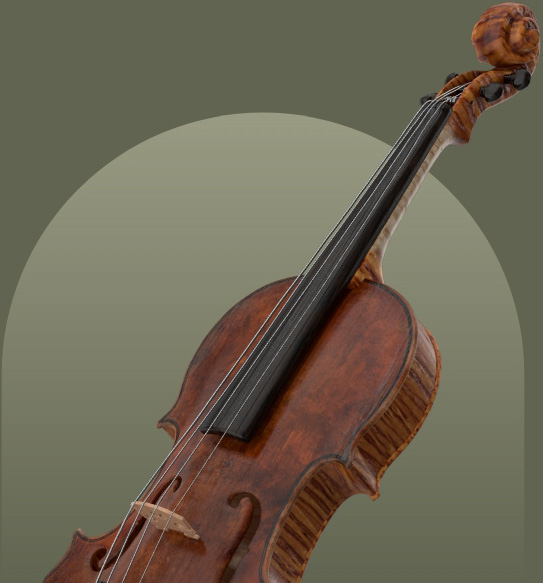
Otto Windisch
1866–1935
Apprenticed to Himmer. Worked for Glaesel and Herwig. Established independently in Schöneck from 1886. His workshop developed into one of the major stringed instrument manufacturing businesses in the region. Retired 1903, passing the management of the firm to his son Paul Windt. — John Dilworth
Auction price history
Highest auction price
| Type | Details | Sold | Price |
|---|---|---|---|
| Violin | 35.7 cm 1880 c. | December 2009 | £900 |
| Violin | 1924 | June 1991 | £660 |
Maker Overview
Characteristics
- Production
- His workshop engaged in mass production, fulfilling orders for up to 10,000 pieces.
- Artist Instruments
- He also dedicated particular care to the production of artist violins, achieving significant success.
- Violoncellos
- His violoncellos, often built after Stradivari models, received widespread recognition for their easy response in all positions and absence of disturbing 'Poltertöne' (rumbling tones).
Influence and legacy
- Training: He was a student of Himmer in Schöneck.
- Work Experience: He worked as an assistant for Gläsel and Herwig.
- Awards: He received a silver medal at the Saxon-Thuringian Exhibition in 1897.
- Awards: He was awarded the gold medal with an honorary cross at the International Industrial Exhibition in Marseille in 1898.
- Awards: Further accolades include awards in Nice in 1899 and a large gold medal in Leipzig in 1901.
- Succession: He passed the management of his firm to his son, Paul Windt, upon his retirement in 1903.
Biographies
The overview above is drawn from the following published accounts. Read them in the original:
John Dilworth+
WINDISCH, Otto Born 1866 Schöneck, died 1935 Schilbach Germany. Apprenticed to Himmer. Worked for Glaesel and Herwig. Established independently in Schöneck from 1886. His workshop developed into one of the major stringed instrument manufacturing businesses in the region. Retired 1903, passing the management of the firm to his son Paul Windt.
Willibald Leo Lütgendorff+
Schüler von Himmer in Schöneck. Als Gehilfe arbeitete er bei Gläsel und Herwig und begründete 1886 sein eigenes Geschäft, das er, da er auch musikalisch gebildet ist, bald in die Höhe brachte, so dass er jetzt durchschnittlich mit 40 Hilfskräften arbeitet und demnach eine der grössten Streichinstrumentenfabriken Deutschlands besitzt. Ausser der Massenfabrikation — es wurden bei ihm bereits Bestellungen auf 10 000 Stück ausgeführt — widmet er sich mit besonderer Sorgfalt der Herstellung von Künstlergeigen und erzielte sehr schöne Erfolge. Vielfache Anerkennung finden auch seine meist nach Stradivari gebauten Violoncelli, die in allen Lagen leicht ansprechen und frei von den oft so störenden Poltertönen sind. Im October 1903 wurde eine Filiale der Fabrik mit Contor und Lager in Schöneck eröffnet Auf der sächs.-thür. Ausstellung 1897 erhielt er die silberne Medaille und auf der Internationalen Industrie-Ausstellung in Marseille 1898 die goldene Medaille mit Ehrenkreuz, ebenso 1899 in Nizza und die grosse goldene Medaille in Leipzig 1901.
Sell your instrument with Amati
Get started by uploading photos of your instrument for our experts to review.
Sell your instrument with Amati
Get started by uploading photos of your instrument for our experts to review.