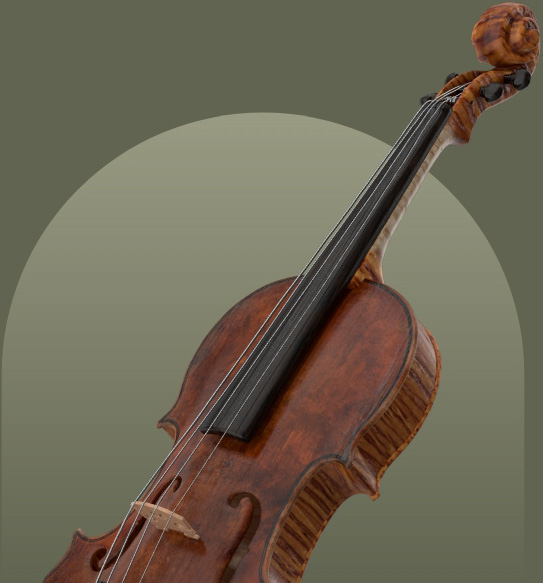
Leopold Renaudin
Paris, 1756–1795
Established at rue des Bouchers, Paris from 1773. Moved c.1774 to rue Saint-Honoré, at the sign ‘Aux Amateurs’. Appointed Luthier to the Conservatoire. An ally of the ruthless revolutionary Jurist Fouquier Tinville, he was tried and guillotined alongside him in 1795. Inconsistent work: some seems ra\u{2026} — John Dilworth
Auction Price History
Highest auction price
19 results
| Type | Details | Auction house | Sold | Price |
|---|---|---|---|---|
| Violin | 36.0 cm Paris, 1783 | — | July 2011 | £6,610 |
| Viola | 39.8 cm Paris, 1778 | — | June 2011 | £11,573 |
| Violin | 35.5 cm 1800 c. Attributed to | — | March 2011 | £1,920 |
| Viola | 39.8 cm Paris, 1786 | — | October 2010 | £12,500 |
| Violin | 36.0 cm Paris, 1783 c. Probably by | — | July 2010 | £6,153 |
| Violin | 36.0 cm Paris, 1792 | — | June 2010 | £3,625 |
| Violin | 36.2 cm Paris, 1780 c., baroqued | — | December 2008 | £2,355 |
| Viola | 39.7 cm Paris, 1786 | — | December 2007 | £9,785 |
| Violin | Paris, 1789 | — | October 2005 | £1,638 |
| Violin | Paris, 1790 c. (repairs) | — | February 2005 | £2,132 |
| Viola | 39.7 cm 1786 | — | December 2002 | £7,945 |
| Violin | 1780 | — | March 2000 | £3,220 |
| Cello | 1790 c. | — | June 1996 | £8,050 |
| Cello | 1791 | — | October 1995 | £9,200 |
| Viola | 39.7 cm 1786 | — | March 1989 | £3,025 |
| Viola | 1776 | — | June 1988 | £8,250 |
| Violin | 1790 | — | November 1981 | £1,010 |
| Violin | 1787 | — | May 1981 | £1,650 |
| Violin | 1775-99 | — | June 1980 | £702 |
No results match those filters.
Maker Overview
Life
Leopold RENAUDIN (1756-1795) was born in Mirecourt in 1756, though Cecie Stainer states his birth year as 1749. He died in Paris in 1795. He established himself at rue des Bouchers, Paris, from 1773, moving around 1774 to rue Saint-Honoré, at the sign 'Aux Amateurs'. He was appointed Luthier to the Conservatoire and Luthier de l'Académie Royale de Musique., he was an ally of the ruthless revolutionary Jurist Fouquier Tinville and was tried and guillotined alongside him in 1795. Henri Poidras and Willibald Leo Lütgendorff corroborate his execution on May 7, 1795, as a member of the Tribunal Fouquier-Tinville. Lütgendorff notes that if the dates on his labels are correct, he arrived in Paris around 1775 and initially appeared very royalist, displaying the Bourbon lily and a ship on his labels. However, during the Revolution, he became a bloodthirsty member of the Tribunal. Lütgendorff also mentions that it is proven a violin maker named Leopold Renaudin was active in Gent around 1781, leading to speculation that he either arrived in Paris later or interrupted his Parisian stay.
Characteristics
- Workmanship
- His work was inconsistent; some instruments, seemed rather thoughtless, featuring a high arch, clumsy scroll, and oxidised dark red varnish. Henri Poidras notes his instruments were arched with a dirty red varnish, while Cecie Stainer describes the varnish as ugly, almost black, and the scroll as badly cut.
- Quality
- Despite inconsistencies, his best instruments, particularly cellos and basses, showed greater refinement, often made on a good Pique/Stradivari model. Henri Poidras states that some of his instruments, chiefly his 'cellos, are of real value.
- Characteristics
- Soundholes were upright and widely spaced with deep fluting to the lower wings.
- Specialization
- His trade card and labels state that he 'cuts instruments that are too large' and 'recoupe quand ils sont d'une forme trop grande'.
- Notable Instruments
- A cello dated 1777 and a violin of 1792 are preserved in the Musée de la Musique, Paris. Examples of his work were exhibited at the Victoria & Albert Museum, London, in 1973. Several of his excellent double-basses were reportedly destroyed by fire at the Paris Opéra in 1873.
- Brand: ‘Renaudin à Paris’ Fait par Léopold Renaudin
Luthier de l’Académie Royale de
Musique à Paris, 1792John Dilworth - Fait par Léopold Renaudin
Luthier de L’Académie Royale de
Musique à Paris, 1780
Aux Amateurs. Renaudin. Luthier
Fait toutes sortes d’Instruments.
rue St. Honoré près de l’Opéra
à Paris. 1784John Dilworth - Aux Amateurs
Renaudin Luthier de l’Académie de Musique
rue St Honoré au coin de celle Jean St Denis.
Fait toutes sortes
d’Instruments de Musique, les raccomode,
les recoupe quand ils sont d’une forme trop grande, et
les remet en état. Il vent toutes sortes de Cordes d’ItalieJohn Dilworth
Biographies
The overview above is drawn from the following published accounts. Read them in the original:
John Dilworth+
RENAUDIN, Léopold Born 1756 Mirecourt, died 1795 Paris France. Established at rue des Bouchers, Paris from 1773. Moved c.1774 to rue Saint-Honoré, at the sign ‘Aux Amateurs’. Appointed Luthier to the Conservatoire. An ally of the ruthless revolutionary Jurist Fouquier Tinville, he was tried and guillotined alongside him in 1795. Inconsistent work: some seems rather thoughtless, with high arch, clumsy scroll, and oxidised dark red varnish. Others, including particularly cellos and basses (several basses reportedly destroyed by fire at the Paris Opéra 1873) show greater refinement. Best instruments on a good Pique/Stradivari model. Soundholes upright and widely spaced with deep fluting to the lower wings. Cello dated 1777 and violin of 1792 in the Musée de la Musique, Paris. Examples of his work were exhibited at the Victoria & Albert Museum, London in 1973. Interestingly and perhaps ironically, his trade card and some labels state that he ‘cuts instruments that are too large’. Signed internally: ‘Fait par Léopold Renaudin à Paris 1792’. Brand: ‘Renaudin à Paris’ Fait par Léopold Renaudin / Luthier de l’Académie Royale de / Musique à Paris, 1792 Fait par Léopold Renaudin / Luthier de L’Académie Royale de / Musique à Paris, 1780 / Aux Amateurs. Renaudin. Luthier / Fait toutes sortes d’Instruments. / rue St. Honoré près de l’Opéra / à Paris. 1784 Aux Amateurs / Renaudin Luthier de l’Académie de Musique / rue St Honoré au coin de celle Jean St Denis. / Fait toutes sortes / d’Instruments de Musique, les raccomode, / les recoupe quand ils sont d’une forme trop grande, et / les remet en état. Il vent toutes sortes de Cordes d’Italie
Cecie Stainer+
b. 1749, at Mirecourt ; guillotined May 7, 1795. He settled in Paris, living in the rue St -Honore from 1776 till his death, at the sign of ” Aux arnateurs.” He made fairly good instruments, but they are too much arched, the scroll is badly cut, and the varnish is ugly, almost black in colour; he made excellent double-basses, several of these, however, were destroyed by the fire at the Opera House in 1873. A violoncello is known made from a bass-viol. In an alto was the label. ” ‘ Aux amateurs.’ Renaudin, luthier, fait toutes sortes d’instruments, rue Saint-Honore pres l’Opera, 1783″; in another alto was the label: “Leopold Renaudin (the address illegible), annee 1789.”
Willibald Leo Lütgendorff+
Wenn die Ziffern auf seinem Zettel richtig sind, dann ist er um 1775 nach Paris gekommen, wo er Geigenmacher der kgl. Musik-Akademie wurde. Auf seinen Zetteln waren die von einer Gloriole umgebene Lilie der Bourbonen und ein Schiff angebracht. Er schien also damals sehr königstreu gewesen zu sein. Während der Revolution schlug er jedoch ganz in das Gegentheil um. Er gehörte zu den blutdürstigsten Mitgliedern des Tribunals Fouquier-Tinville und wurde auch zugleich mit Fouquier und 15 Anderen am 7. Mai 1795 selbst guillotinirt. — Es ist erwiesen, dass ein Geigenmacher Leopold Renaudin um 1781 in Gent ansässig war. Die ältesten Instrumente aus Paris von ihm mit zweifellos echten Jahreszahlen sind von 1783. Wenn man nicht annehmen will, dass er einen gleichnamigen Vetter gehabt hat, so muss man vermuthen, dass er entweder erst nach 1781 in Paris eingetroffen ist, oder dass er seinen Pariser Aufenthalt für einige Zeit unterbrochen hatte. Als Geigenmacher war er zweiten Ranges; die Arbeit ist nicht schlecht, das Modell aber unfein, die Wölbung ziemlich hoch und die Schnecke plump; am schlechtesten ist sein Lack von schmutzig-gelber oder fast schwarzer Farbe. Er hatte eine hübsche Geschäftskarte und benutzte verschiedene Zettel.
Henri Poidras+
Sign-board : «Aux Amateurs ». Good Parisian make, of the second order however, this maker having been very inconsistent in his work. His instruments are arched and the colour of varnish used is that of dirty red. Among them sone are are of real value, chiefly his ‘cellos. His mark is sometimes branded on the scroll. As a member of the Tribunal Fouquier-Tinville he was executed with those of the ?jury known as « Les Solides » (The Strong) on the 7th May 1795.
Sell your instrument with Amati
Get started by uploading photos of your instrument for our experts to review.
Sell your instrument with Amati
Get started by uploading photos of your instrument for our experts to review.