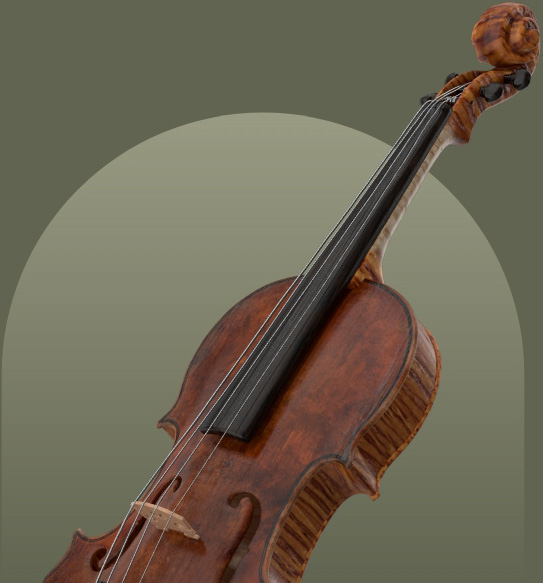
Franz Xaver Steininger
c.1778–1852
Franz Xaver Steininger (1778-c.1852) was a German violin maker, pupil of his father Jacob Steininger, who worked extensively across Europe. Born in Mainz, he moved with his family to Aschaffenburg and later worked in Linz, Vienna, Darmstadt, and Frankfurt, where he gained citizenship. Driven by wars, he relocated to St. Petersburg, Russia, in 1806, returning to Frankfurt in 1818. He also spent time in Paris (1827-1828), collaborating with J. Thibout, before moving back to St. Petersburg around 1837. His instruments, particularly his 'cellos, are noted for their adherence to classical Cremonese models, accurate craftsmanship, and fine golden-yellow varnish. His Parisian work adopted a distinct French character. He is recognized for his quality instruments and is considered by the French to be among the Parisian masters.
Maker Overview
Life
Franz Xaver Steininger (1778-c.1852) was born in 1778 in Mainz, Germany, and passed away around 1852 in St. Petersburg, Russia, though Henri Poidras suggests his death occurred in 1850. He was the pupil of his father, Jacob Steininger, and the grandson of N. Dopfer, as well as the nephew of Martin Diehl. The Steininger family departed Mainz in 1792 due to the revolutionary wars, briefly residing in Frankfurt before settling in Aschaffenburg with the court of Frederick, Elector of Saxony. His cousin, Nicolaus Diehl, joined the family workshop in Aschaffenburg after the death of his father, Martin, during the siege of Mainz. Franz Xaver Steininger subsequently worked with M. Frank in Linz and also in Vienna. Around 1801, he was appointed 'hofgeigenmeister' in Darmstadt, but finding insufficient business there, he relocated to Frankfurt. By 1803, he was granted citizenship in Frankfurt. However, by 1806, the situation had deteriorated, and the ongoing wars compelled him to move to St. Petersburg, possibly after brief stays in Paris, London, Berlin, and Warsaw. His brother, Johann Martin Steininger, later joined him in St. Petersburg. Franz Xaver Steininger returned to Frankfurt in 1818, where he remained until 1835. During 1827 and 1828, he was again in Paris, collaborating with J. Thibout. He then returned to Frankfurt before moving once more to St. Petersburg around 1837., his first wife died in 1805, and he married Elisabeth Kauth from Bensheim in 1819. Frankfurt trade calendars listed him until 1835 as a 'streichenden Instrumentenmacher in der Meisengasse wohnhaft' (stringed instrument maker residing in Meisengasse). Frankfurt address books from 1835 to 1852 identified him as an 'auswärts wohnenden Bürger' (citizen living abroad), specifically as a violin maker in St. Petersburg. His name is absent from these records starting in 1853, suggesting his death occurred around that time.
Characteristics
- Workmanship
- His work generally adheres to good classical Cremonese models.
- Head Characteristics
- Heads are characteristically slightly cramped with shallow undercuts, a deep throat, and a flattened chin.
- Construction
- Instruments are accurately made and well-finished, utilizing decent materials.
- Varnish
- He typically employed a golden-yellow varnish, and Willibald Leo Lütgendorff notes that his varnish was not bad.
- Parisian Style
- Work executed in Paris exhibits a thoroughly French character and could easily be mistaken for high-quality commercial work of that place and period.
- Improvements
- Willibald Leo Lütgendorff states that he made improvements to the bass bar that proved effective.
- Materials
- He consistently used very beautiful wood.
- Fransiscus Steininger
Mogenstinus Paris 1828John Dilworth - Franz Steininger Asschaffenburg
1800John Dilworth
Influence and legacy
- Mentorship: He was a pupil of his father, Jacob Steininger.
- Family Connections: He was the grandson of N. Dopfer and the nephew of Martin Diehl.
- Collaborations: He worked with M. Frank in Linz and Vienna, and later with J. Thibout in Paris during 1827 and 1828.
- Artistic Influences: Willibald Leo Lütgendorff notes that he studied the Italians, and the French school also exerted an influence on his work.
- Reputation: His 'cellos are particularly beautiful and sought after for their tone qualities.
- Auction Records:, two of his violoncellos sold for £16 and £26 respectively at a Paris sale in 1887. Willibald Leo Lütgendorff specifies that one of his violoncellos from 1828 sold for 650 francs at a Paris auction in 1887.
- Recognition: The French consider him among the Parisian masters.
Biographies
The overview above is drawn from the following published accounts. Read them in the original:
John Dilworth+
STEININGER, Franz Xaver Born 1778 Mainz Germany, d.c.1852 St. Petersburg Russia. Pupil of his father Jacob Steininger, below. Grandson of N. Dopfer and nephew of Martin Diehl. The family left Mainz in 1792 as a result of the revolutionary wars, staying briefly in Frankfurt and then settling in Aschaffenburg with the court of the Frederick, Elector of Saxony. Joined in the family workshop there by his cousin Nicolaus Diehl, after the death of his father Martin in the siege of Mainz. Franz went on to work with M. Frank in Linz and also in Vienna. Appointed ‘hofgeigenmeister’ in Darmstadt c.1801, but found insufficient business there and moved to Frankfurt. By 1803 he was granted citizenship there. However by 1806 the situation had deteriorated and the wars drove him to St Petersburg, possibly by way of brief stays in Paris, London, Berlin, and Warsaw. In St Petersburg he was joined by his brother Johann Martin Steininger, below, but returned to Frankfurt 1818 where he remained until 1835. In 1827 and 1828 he was again in Paris, working with J. Thibout, returning to Frankfurt and moving once again to St Petersburg c.1837. His work generally follows good classical Cremonese models. Heads are characteristically slightly cramped with shallow undercuts, deep throat, and flattened chin. Accurately made and well-finished. Decent materials and generally golden-yellow varnish. Work done in Paris has a thoroughly French character and would easily be taken for high-quality commercial work of that place and period. Manuscript labels: Fransiscus Steininger / Mogenstinus Paris 1828 Franz Steininger Asschaffenburg / 1800 [Michels]
Cecie Stainer+
A maker in Paris in 1827. He made excellent instruments, the work finished with care, the varnish of fine quality. In 1887, at a sale in Paris, two violoncellos of his sold for £16 and £26 respectively. Label: ” F. Steininger, Paris, 1827.”
George Hart+
Son of Jacob Steininger.
Willibald Leo Lütgendorff+
Sohn und Schüler von Jakob St. Als sein Vater von Frankfurt nach Aschaffenburg berufen wurde, ging er auf die Wanderschaft, arbeitete hauptsächlich in Linz und Wien und kam vermuthlich bis nach Paris. Im Jahre 1800 war er wieder in Aschaffenburg und erhielt einen Ruf als Hof-Geigenmacher nach Darmstadt. Dort scheint er jedoch keine ausreichende Beschäftigung gefunden zu haben, denn schon 1801 siedelte er nach Frankfurt, wo er seine Lehrzeit zugebracht, über und wo ein Geigenmacher sehr nöthig war. Er fand bald einen grossen Kundenkreis, und als er sich 1802 um das Bürgerrecht bewarb, konnte er eine Reihe glänzender Zeugnisse vorlegen. Gegen die Verpflichtung, nur von ihm gemachte Geigen zu verkaufen und die Instrumente der städtischen Capelle an der Katharinenkirche lebenslänglich unentgeltlich zu unterhalten, wurde ihm und seiner Frau, einer gebornen Bernritter aus Aschaffenburg, 1803 das Bürgerrecht ertheilt. Nun kamen aber schlechte Zeiten und schwere Schicksalsschläge für ihn. 1805 starb seine Frau, die Kriegsjahre von 1806 an brachten ihn in seinem Erwerb zurück, die unerschwinglichen Kriegslasten ruinirten ihn vollends, so dass er sich entschloss, eine Kunstreise zu unternehmen. Er liess seinen jüngeren Bruder in der Frankfurter Werkstatt zurück und ging nach St. Petersburg, wo er bald so reichliche Anerkennung und lohnende Arbeit fand, dass er seinen Bruder, der ohne ihn nicht leben zu können angab, nachkommen liess. Vorher war er wohl wieder in Paris; auch in London scheint er sich aufgehalten zu haben, wie auch in Berlin und Warschau. Erst im Jahre 1818 kehrte er, nur ungern in St. Petersburg entlassen, nach Frankfurt zurück und erhielt das Bürgerrecht wieder. Sein Gesuch darum wurde von den ersten Musikern, darunter von Louis Spohr, der damals Operndirector in Frankfurt war, wärmstens unterstützt. Im Jahre 1819 heirathete er Elisabeth Kauth aus Bensheim und blieb jetzt mit kurzen Unterbrechungen bis 1835 in Frankfurt; nur von 1827—1828 arbeitete er in Paris. Die Frankfurter Gewerbekalender führen ihn bis 1835 als »streichenden Instrumentenmacher in der Meisengasse wohnhaft« auf. Die Frankfurter Adressbücher von 1835—1852 nennen ihn als auswärts wohnenden Bürger, und zwar als Geigenmacher in St. Petersburg. Von 1853 ab fehlt sein Name; er scheint also um diese Zeit schon gestorben gewesen zu sein. Er war ein feiner Künstler, der auch Verbesserungen am Bassbalken anbrachte, die sich bewährt haben. Seine Arbeiten beweisen, dass er die Italiener studirt hat; die französische Schule ist ebenfalls nicht ohne Einfluss auf ihn gewesen; ja, die Franzosen rechnen ihn kurzweg zu den Pariser Meistern. Besonders schön sind seine Violoncelli, von denen eines von 1828 auf einer Pariser Auction schon 1887 mit 650 frcs. bezahlt wurde. Er nahm nur sehr schönes Holz und war auch im Lack nicht schlecht.
Henri Poidras+
Paris 1778-1850. Originally from Mayence, this German maker, although working for only a short time in Paris, has adopted the French style and has left some fine instruments, among them his ‘cellos, which are sought after for their tone qualities.
Sell your instrument with Amati
Get started by uploading photos of your instrument for our experts to review.
Sell your instrument with Amati
Get started by uploading photos of your instrument for our experts to review.