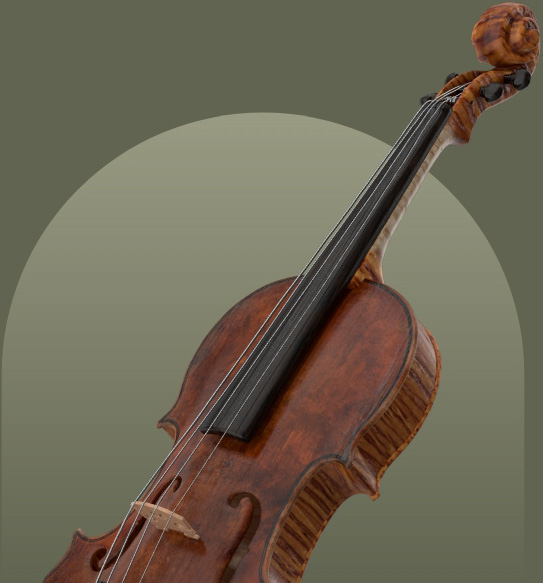
Milan School
Carlo Antonio Testore
Milan, c.1693–1765
Carlo Antonio Testore, born around 1688 and active until after 1764, was a prominent Milanese violin maker and the eldest son and pupil of Carlo Giuseppe Testore. He established his workshop in Milan's Contrada Larga, identified by the sign of the Eagle. Known for crafting instruments of high quality, he often adopted the patterns of Guarneri and Amati, and occasionally Stradivari. His instruments, including violoncellos and altos, are characterized by excellent wood, good workmanship, a powerful tone, and distinctive golden-yellow or thick brown varnish. His unique models are noted for their larger pattern and higher arching compared to his father's works, and open sound holes in the Guarneri style. He also associated with his son Giovanni in his later years.

Instruments


Auction price history
Highest auction price
54 results
| Type | Details | Auction house | Sold | Price |
|---|---|---|---|---|
| Violin | Labelled Carlo Antonio Testore figlio Maggiore del fu Carlo Giuseppe in contrada larga al segno ... Lot 92 | Tarisio | October 2024 | £72,000est. £ 30,000-50,000 |
| Violin | Labelled Carlo Antonio Testore figlio maggiore del fu Carlo Giuseppe in Contrada larga al Segno ... Lot 180 | Ingles & H. | October 2024 | £90,000est. £ 80,000-120,000 |
| Violin | Labelled Carlo Antonio Testore figlio Maggiore del fu Carlo Giuseppe in Contrada larga al segno ... Lot 146 | Tarisio | May 2024 | £51,830est. $ 50,000-80,000 |
| Violin | Labelled Carlo Giuseppe Testore in Contrada ..., with the collaboration of his brother Paolo Antonio Lot 60 | Tarisio | March 2024 | £78,000est. £ 60,000-90,000 |
| Cello | Labelled Carlo Giuseppe Testore in Contrada Larga di Milano al Segno dell'Aquila 1721 Lot 80 | Ingles & H. | March 2024 | £144,000est. £ 60,000-80,000 |
| Violin | Labelled Carlo Antonio Testore figlio, del qu. ..., back of the head fluted and purfling to back added later Lot 111 | Tarisio | February 2024 | £81,960est. € 70.000-100.000 |
| Violin | 35.4 cm Milan, 1740 c. | — | November 2011 | £31,952 |
| Violin | 35.7 cm Ascribed to | — | October 2011 | £10,000 |
| Cello | 76.6 cm Attributed to | — | June 2011 | £24,000 |
| Viola | 42.0 cm Milan, 1752 | — | May 2011 | £172,860 |
| Violin | 36.2 cm 1780 c. Probably by | — | December 2010 | £7,200 |
| Violin | 35.8 cm Milan, 1750 c. Attributed to | — | March 2010 | £32,400 |
| Violin | 35.7 cm 18th C. Ascribed to | — | May 2009 | £8,540 |
| Cello | 73 cm Milan, mid-18th C. | — | March 2009 | £43,250 |
| Violin | 35.0 cm Milan, mid-18th C. | — | March 2009 | £25,000 |
| Violin | 35.7 cm Milan, 1720 | — | November 2008 | £37,050 |
| Violin | 35.9 cm Milan, 1735 c. | — | October 2008 | £49,250 |
| Cello | 63.6 cm Milan, 1740 1/2 Size | — | March 2008 | £14,040 |
| Violin | 35.7 cm Milan, 1730 c. | — | March 2008 | £52,650 |
| Violin | 35.4 cm Milan, 1763 c. | — | October 2007 | £62,439 |
| Violin | 35.7 cm Milan, 1741 c. | — | April 2007 | £36,389 |
| Violin | 35.3 cm Milan, 1750 c. Probably by | — | April 2007 | £5,155 |
| Violin | 35.7 cm Attributed to | — | February 2007 | £3,242 |
| Viola | 39.4 cm Milan, 18th C. Attributed to | — | November 2006 | £14,400 |
| Violin | 35.6 cm first half of 18thC Attributed to | — | November 2006 | £10,851 |
| Violin | 35.4 cm Milan, 1750 c. | — | May 2006 | £24,527 |
| Cello | Milano, 1691 | — | November 2005 | £15,790 |
| Violin | Milan, 1745 c. | — | November 2005 | £36,122 |
| Violin | Ascribed to | — | April 2005 | £6,266 |
| Violin | — | October 2004 | £27,225 | |
| Violin | 1740 c. | — | May 2004 | £16,577 |
| Violin | Attributed to | — | May 2004 | £5,975 |
| Violin | Milan, 1730 | — | May 2004 | £48,113 |
| Violin | 1750 c. | — | November 2003 | £45,600 |
| Violin | 1740 c. | — | October 2003 | £23,748 |
| Violin | 1750 c. | — | July 2003 | £27,600 |
| Violin | 1738 | — | July 2003 | £34,250 |
| Violin | 1753 | — | October 2002 | £58,050 |
| Violin | 1755 | — | June 2002 | £50,190 |
| Violin | 1733 | — | March 2002 | £23,500 |
| Violin | 1721 | — | May 2000 | £51,623 |
| Violin | 1735 | — | November 1999 | £32,200 |
| Violin | 1750 | — | March 1999 | £19,550 |
| Violin | 1770 | — | March 1999 | £35,000 |
| Violin | 1750 c. | — | November 1998 | £18,400 |
| Violin | 1742 | — | November 1996 | £31,050 |
| Violin | 1768 | — | March 1996 | £33,350 |
| Violin | 1751 | — | November 1995 | £42,550 |
| Violin | 1750 c. | — | October 1995 | £29,900 |
| Violin | 1728 | — | November 1994 | £18,975 |
| Violin | 1760 c. | — | November 1993 | £12,635 |
| Violin | 1743 | — | April 1993 | £16,100 |
| Cello | 1766 | — | June 1987 | £35,200 |
| Cello | 1723 | — | July 1985 | £29,700 |
No results match those filters.
Maker Overview
Life
Carlo Antonio Testore (c. 1688 – after 1764) was a Milan-based violin maker who carried forward his family's craft into the mid-18th century. The eldest son of Carlo Giuseppe Testore, he trained under his father before establishing his own reputation during an active period from approximately 1735-1765. Working from the family's traditional location in Milan's Contrada Larga at the sign of the Eagle, Carlo Antonio eventually brought his son Giovanni into the business, creating a three-generation dynasty of instrument makers.
Characteristics
- Innovation
- His own model is large and heavy of aspect. His works differ from those of his father, Carlo Giuseppe Testore, by their larger pattern and higher arching.
- Materials
- He used excellent wood, though not always finely figured, and consistently employed very good wood in his instruments.
- Methods
- Carlo Antonio Testore made his violins on the Guarneri pattern, and also copied models by Nic. Amati, Guarneri del Gesu, and occasionally Stradivari. His instruments are described as bold and well made, with good workmanship. He applied varnish that was either golden-yellow or a rather thick brown colour.
- Branded internally and with double-eagle mark: ‘C.A.T.’ Carlo Antonio Testore figlio maggiore
del fu Carlo Giuseppe in Contrada lar-
ga al segno dell’ Aquila, Milano 1741John Dilworth - Carlo Antonio e Giovanni padre e figlio
Testori, il qual Carlo e figlio maggiore
del fu Carlo Giuseppe Testore, abitanti
in Contrada larga al segno dell’ Aquila
Milano, 1764John Dilworth
Influence and legacy
- Training and Mentorship: He was the son and pupil of Carlo Giuseppe Testore.
- Schools/Tradition: He worked on the models of prominent makers such as Nic. Amati, Guarneri del Gesu, and occasionally Stradivari.
- Notable Associations: Carlo Antonio Testore was associated with his son Giovanni, as indicated by a label from 1764.
- Modern Recognition: His instruments are considered excellent and valued for their craftsmanship and tonal qualities.
Biographies
The overview above is drawn from the following published accounts. Read them in the original:
John Dilworth+
TESTORE, Carlo Antonio Born circa. 1693, d.c.1765 Milan Italy. Son, pupil, and successor of Carlo Giuseppe Testore, below, at the sign ‘dell’Aquila’ in Contrada Larga. More prolific maker than his father, but generally a less conscientious craftsman. Assisted in later years by his own son Giovanni. Instruments often lacking purfling, with the lines scratched into the edges of the plates, and the back of the pegbox left flat. Where purfling is used it is generally of beech wood. Soundholes usually of Stradivari or Amatisé form, but poorly cut and with small unfluted wings and finial circles. Scrolls have a pronounced ovality to the outline along the plane of the fingerboard. Golden-yellow to plain brown varnish and often very plain materials. Branded internally and with double-eagle mark: ‘C.A.T.’ Carlo Antonio Testore figlio maggiore / del fu Carlo Giuseppe in Contrada lar- / ga al segno dell’ Aquila, Milano 1741 Carlo Antonio e Giovanni padre e figlio / Testori, il qual Carlo e figlio maggiore / del fu Carlo Giuseppe Testore, abitanti / in Contrada larga al segno dell’ Aquila / Milano, 1764
Cecie Stainer+
Eldest son of Carlo Giuseppe Testore, from whom he learnt his trade. Worked in Milan, in the Contrada Larga, at the sign of the Eagle (dell’ aquila), about 1735-65 ; according to one label was associated with his son Giovanni in 1764. His violins are made on the Guarneri pattern, of excellent wood, though not finely figured; the varnish is golden-yellow in colour, the workmanship is good. His violoncellos and altos are especially fine instruments; the varnish, rather thick, is generally brown in colour. Labels: ” Carlo Antonio Testore figlio maggiore del fu Carlo Giuseppe in Contrada larga al segno deir aquila, Milano, 1741 ” ; another label is dated 1736: “Carlo Antonio e Giovanni padre e figlio Testori, il qual Carlo e figlio maggiore del fu Carlo Giuseppe Testore, abitanti in Contrada larga al segno dell’ aquila, Milano, 1764
George Hart+
Son of Giuseppe. Copied Guarneri and Amati. These instruments are bold and well made ; their tone is excellent.
Willibald Leo Lütgendorff+
Älterer Sohn und Schüler von Carlo G. T. Er arbeitete nach Nic. Amati, Guarneri u. Strad., verwendete meist sehr gutes Holz und einen goldgelben, in’s Bräunliche spielenden Lack, der nur zu dick ist und wenig Feuer hat. Er wohnte in der Contrada Larga und hatte wie sein Vater das Ladenschild »all’ aquila«, wesshalb er auch eine Brandmarke anbrachte, die einen Adler vorstellte. In seinen letzten Jahren arbeitete er gemeinsam mit seinem Sohne Giovanni. Ihre Geigen zeichnen sich durch Tonfülle aus.
Henri Poidras+
Milan circa 1680-1760. Son and pupil of Carlo-Giuseppe. Amati and Guarnerius models. His own model is large and heavy of aspect. The sound holes, after the Guarneri manner, are very open. Thick yellow-brown varnish. Excellent instruments. Apart from the label, an eagle is branded.
Karel Jalovec+
Milan. Born about 1688, died after 1764. Son and pupil of Carlo Giuseppe Testore. His works differ from those of his father by their larger pattern and higher arching. He worked on the models of Nic. Amati, Guarneri del Gesu and occasionally on that of Stradivari. The wood he used is very good. He applied a golden yellow varnish. The tone of his instruments is powerful and of good quality. Valued instruments. Price 45 — 50.000 Kc.
Sell your instrument with Amati
Get started by uploading photos of your instrument for our experts to review.
Sell your instrument with Amati
Get started by uploading photos of your instrument for our experts to review.