Milan School
Fedele Barnia
Milan, worked 1745–1780
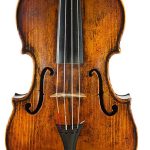
Fedele Barnia was a luthier born in Milan who established his workshop in Venice, active from approximately 1745 to 1780. He produced violins, theorbos, mandores, and violoncellos. While considered a skilled master, his violin craftsmanship could be uneven, with his best work often adhering to established models. He was noted for his transparent yellow varnish and for dedicating particular attention to inlay work on his mandolins and theorbos. There is conflicting information regarding whether he was a pupil of Pietro Guarneri, though some of his violins show stylistic similarities to Guarneri's work.
Maker Overview
Life
Fedele Barnia was born in Milan and later settled in Venice, Italy, where he is cited by John Dilworth as working between approximately 1745 and 1780., he was born in Milan and settled in Venice. Willibald Leo Lütgendorff also states that he originated from Milan. John Dilworth records labels bearing his name dated 1770 and 1750, specifically "Fedele Barnia Milanese / fece in Venezia, l'anno 1770" and "Fedele Barnia Milanese / fece in Venezia 1750". Lütgendorff notes that Vidal's reading of a date as 1715 is likely an error, suggesting it should probably be 1775.
Characteristics
- Instruments
- Fedele Barnia is known for producing violins, a theorbo, a mandore, and a small violoncello.
- Workmanship
- Willibald Leo Lütgendorff describes him as a skilled master, though his work often exhibited a craftsman-like quality, leading to uneven value in his violins. Lütgendorff suggests that Barnia's best work occurred when he adhered to good models; when he was original, his pieces were considered "unschön" (unbeautiful). He was not considered an artist in carving scrolls and did not consistently pay careful attention to wood selection or inlays, except for his mandolins.
- Varnish
- Cecie Stainer notes that a small violoncello by Barnia featured a yellow varnish that was somewhat transparent. Lütgendorff also describes his varnish as transparent yellow.
- Inlay Work
- Lütgendorff highlights that Barnia dedicated more effort to inlay work on his mandolins, exemplified by a beautiful theorbo in the Gautier collection in Nice.
- Style
- John Dilworth records one violin by Barnia as being in the style of P. Guarneri of Venice.
- Fedele Barnia Milanese
fece in Venezia, l’anno 1770John Dilworth - Fedele Barnia Milanese
fece in Venezia 1750John Dilworth
Influence and legacy
- Mentorship: Sources contain conflicting information regarding Fedele Barnia's potential mentorship. Cecie Stainer states he was "Probably a pupil of Pietro Guarneri." However, Willibald Leo Lütgendorff notes that while De Piccolellis believed Barnia might have been a pupil of Pietro Guarneri due to a violin built in Guarneri's style, Lütgendorff disagrees with this assessment, citing Barnia's transparent yellow varnish as evidence against it.
- School: Willibald Leo Lütgendorff observes that Fedele Barnia's work reminds one somewhat of the Milanese school.
Biographies
The overview above is drawn from the following published accounts. Read them in the original:
John Dilworth+
BARNIA, Fedele b. Milan, Worked 1745-1780 Venice Italy. Cited by Vidal. Known for a theorbo and mandore bearing his label. One violin recorded, said to be in the style of P. Guarneri of Venice, with his label dated 1770. Fedele Barnia Milanese / fece in Venezia, l’anno 1770 Fedele Barnia Milanese / fece in Venezia 1750
Willibald Leo Lütgendorff+
Er stammt aus Mailand und erinnert in seiner Arbeit auch ein wenig an
die Mailänder Schule. Er war ein geschickter Meister, der nur zu oft handwerksmässig
gearbeitet hat. Seine Geigen sind daher von ungleichem Werth;
am besten ist er dann, wenn er sich an gute Vorbilder hält; wo er originell ist,
ist er auch unschön, um so mehr, als er kein Künstler im Schnitzen der
Schnecken war und auf die Wahl des Holzes und die Einlagen keine Sorgfalt
verwendete, nur bei seinen Mandolinen gab er sich bei der Einlegearbeit mehr
Mühe, wie eine hübsche Theorbe in der Sammlung Gautier in Nizza beweist.
Wenn Vidal die Jahreszahl 1715 liest, so scheint dies ein Fehler zu sein, es
muss wohl 1775 heissen. De Piccolellis muss eine nach P. Guarneri gebaute
Geige von ihm gekannt haben, da er es für möglich hält, dass er ein Schüler
dieses Meisters gewesen sei, was ich nicht zugeben kann. Auch sein Lack, trotzdem
er durchsichtig gelb ist, spricht dagegen.
Cecie Stainer+
b. at Milan ; settled in Venice. Probably a pupil of Pietro Guarneri. A small violoncello is known, of accurate proportions, with yellow varnish somewhat transparent, and good tone.
one dated 1715 was found in a very beautiful theorbo.
Sell your instrument with Amati
Get started by uploading photos of your instrument for our experts to review.
Sell your instrument with Amati
Get started by uploading photos of your instrument for our experts to review.