
London School
Edward Newman (Edward II) Withers
London, 1844–1915
Edward Newman (Edward II) WITHERS (1844-1915) was a prominent English violin maker, son and pupil of Edward (I) Withers and John Lott (II). Active from 1856, he took control of the family business after his father's death, establishing his workshop at 22 Wardour Street, which operated under the Withers name until 1991. Appointed violin maker to the Duke of Edinburgh in 1893, he was known for his prolific output of about twelve instruments annually, crafted on Stradivari and Guarneri models using carefully selected wood and a distinctive oil varnish application method. He also invented the "E. Withers' Patent Prepared Hollow Sound-Post" and was esteemed as a bow maker. His three sons later assisted him in the business, continuing his legacy.
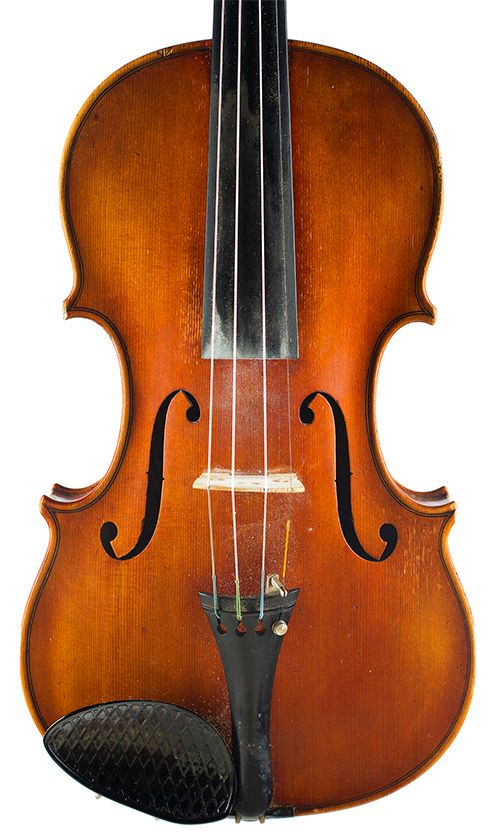

Auction price history
Highest auction price
| Type | Details | Sold | Price |
|---|---|---|---|
| Violin | 35.9 cm London, 1900 c. | March 2008 | £1,875 |
| Viola | 40.3 cm London, 1900 c. | March 2008 | £2,750 |
| Violin | 35.7 cm Late 19th C. | February 2007 | £5,411 |
| Violin | 1880 c. | September 2003 | £3,407 |
| Violin | 1900 c. | May 2001 | £1,300 |
| Cello | 1880 c. | November 1995 | £7,475 |
| Violin | 188- | November 1995 | £1,092 |
| Violin | 1879 | October 1995 | £1,725 |
| Viola | 39.2 cm 1900 c. | December 1993 | £1,320 |
| Violin | 1880-99 | November 1992 | £1,150 |
| Viola | 40.2 cm 1890 c. | June 1992 | £2,090 |
| Violin | 1900-10 | March 1991 | £1,320 |
| Violin | 1880 c. | November 1990 | £1,540 |
| Violin | 1880 c. | September 1989 | £1,760 |
| Violin | 1888 | March 1984 | £715 |
Maker Overview
Life
Edward Newman (Edward II) WITHERS (1844-1915) was born in London, UK, on October 22, 1844, and died in 1915. He was the son and pupil of Edward (I) Withers. He commenced business at 31 Coventry Street, London, in 1856. Initially, he worked with his brother George, but they separated shortly after their father's death, with Edward (II) taking control of the main business. Edward (II) established a new shop at 12 Princes Street in 1878, which was renamed 24 Wardour Street the following year. In 1881, he moved again to 22 Wardour Street, an address that remained open under the Withers name until 1991. He was appointed violin maker to H.R.H. the Duke of Edinburgh on June 1, 1893. Edward (II) was notably more active as a practical violin maker than his father, though he also utilized an experienced workshop.
Characteristics
- Production Rate
- He was said to produce approximately twelve instruments annually, with some sources stating he completed only one violin per month, executing all parts himself.
- Models
- He exclusively copied the Stradivari and Guarneri models.
- Wood
- He used very old and carefully selected wood.
- Varnish
- His varnish was entirely oil-based, varying in color from amber to brown, red, or golden red. He applied amber varnish first, allowing the instrument to dry for some years before applying the color, which was also oil-based. He held a strong belief that varnish significantly affects tone quality, leading him to conduct extensive experiments to understand the "secret out of the great Ghost of Cremona." His varnish is described as exceedingly good, well-laid, rich, "juicy," and perfectly transparent.
- Instrument Types
- He made a large number of instruments, including violins, tenors, and violoncellos.
- Innovation
- In November 1896, Mr. Withers invented the "E. Withers' Patent Prepared Hollow Sound-Post."
- Bow Making
- He was also esteemed as a bow maker, with a great reputation in England for his bows.
- Notable Instruments
- Around 1870, he made a quartet (two violins, viola, and 'cello) from a beam of maple found in his loft. This quartet is considered the finest known in England and was in the possession of his sons.
- Prices
- His prices were violins and tenors from £10 to £65, and violoncellos from £20 to £150.
Influence and legacy
- Teachers: He was the son and pupil of his father, Edward (I) Withers, and also a pupil of John Lott (II).
- Collaboration: He worked with his father for a period of over twenty-five years, during which he made many new instruments and executed nearly all the principal repairs entrusted to the firm.
- Royal Appointment: He was appointed violin maker to H.R.H. the Duke of Edinburgh in 1893.
- Family Business: His three sons, Edward Sidney Munns (born August 3, 1870), Sidney Bernard (born October 22, 1873), and Douglas Sidney (born August 10, 1879), assisted him in the business.
- Business Longevity: The business at 22 Wardour Street remained open under the Withers name until 1991.
- Esteem: Violins by him are esteemed and sought after.
Biographies
The overview above is drawn from the following published accounts. Read them in the original:
John Dilworth+
WITHERS, Edward Newman (Edward II) Born 1844, died 1915 London UK. Son and pupil of Edward (I) above, active from 1856. Also taught by John Lott (II). Initially worked with his brother George, below, but the brothers fell out almost immediately after the death of Edward (I). Edward (II) took control of the business while George moved to separate premises on St Martin’s Lane, London. Edward established a new shop at 12 Princes Street in 1878, the same building renamed as 24 Wardour Street the following year. In 1881 he moved again to 22 Wardour Street, which remained open under the Withers name until 1991. Appointed violin maker to the Duke of Edinburgh in 1893. Worked twenty-four years with father. Moved to Wardour Street. Edward (II) was certainly more active as a practical violin maker than his father, although he also had an experienced workshop to draw upon. Said to have produced up to twelve instruments annually on Stradivari and Guarneri models. Very fine work in the manner of John Lott.
Cecie Stainer+
Eldest son of Edward Withers, b. Oct. 22, 1844. Pupil of his father and John Lott Commenced business at 31, Coventry Street, London, in 1856; moved later to 22, Wardour Street. He employs no workmen, and makes about twelve instruments per year, on the Stradivari and Guarneri patterns, using good oil varnish, an amber colour.
William Meredith Morris+
He was born in London, Oct. 22, 1844, and is the eldest son of the above Edward Withers. He received his early education at Fulham. He is the only pupil of his father and of John Lott, the well-known violin-maker. He commenced business at 31 Coventry Street, London, in 1856, and moved later to 22 Wardour Street. He worked with his father for a period of over twenty-five years, and during that time made many new instruments, and also executed nearly all the principal repairs that were entrusted to the firm. Mr. Withers copies exclusively the Stradivarius and Guarnerius models, using very old and carefully selected wood. His varnish is entirely oil, and varies in colour from amber to brown and red or golden red. His method of varnishing is unique. He always puts amber varnish on the wood and then hangs the fiddle up to dry for some years before putting the colour on. The colour is also oil. He has made a large number of instruments, including violins, tenors, and violoncellos. He turns out on an average about twelve instruments per year. All these reach a high standard of excellence, and are characterised as much for their beautiful tone as for their exquisite appearance. His prices art : violins and tenors from £10 to £65 ; violoncellos from £20 to £150. On June 1, 1893, he was appointed by Royal Warrant violin-maker to H.R.H. the Duke of Edinburgh. Three sons now assist him in the business. These are : Edward Sidney Munns, born Aug. 3, 1870 ; Sidney Bernard, born Oct. 22, 1873 ; and Douglas Sidney, born Aug. 10, 1879. In Nov. 1896 Mr. Withers invented the new sound-post, now universally known as “E. Withers’ Patent Prepared Hollow Sound-Post.” Mr. Withers is one of those who believe in oil varnish. He expresses a strong belief that the varnish affects the quality of the tone to an extent not allowed by the majority of writers on the subject. Acting on this belief he was led early in life to pay a close attention to the varnish question, and to conduct a series of experiments with the view of wringing the secret out of the great Ghost of Cremona. It is this belief also which prompts him now to spend such time over the varnishing process. Certain it is that his varnish is exceedingly good and well laid on. It is rich, “juicy,” and withal perfectly transparent. Mr. Withers plays the violin, tenor and ‘cello, and has frequent quartet and symphony parties at his private house, Elmwood, Atkins Road, Clapham Park. His label, it will be observed from the following facsimile, is not dated. It is almost identical with that used by his father, only having in addition the name of the street and number of the house.
Willibald Leo Lütgendorff+
Ältester Sohn und Schüler von Edw. I. W. und John Lott. Er wurde der Nachfolger seines Vaters und verlegte seine Werkstatt in die Wardour Street No. 22, wo sie sich noch befindet. Er arbeitet nach Stradivari und Guarneri, und da er sehr sorgfältig arbeitet, stellt er monatlich nur eine Geige fertig, die er in allen Theilen allein ausführt und mit Bernsteinlack (in verschiedenen Farben) lackirt. Auch als Bogenmacher ist er geschätzt.
Henri Poidras+
London. 22 Leicester Square. Born in 1844, died in 1915. Son, pupil and successor of Edward Withers. Like his father, he followed the model of the Cremonese master and gave his work very minute care. His varnish is of a tender composition, an inducement to good tone. Violins by him are esteemed and sought after, and this also applies to his bows, his reputation in England as a bow maker being great. In 1893 he was appointed violin maker to the Duke of Edinburgh. Towards 1870 he made a quartet (2 violins, viola and ‘cello), which it is said is the finest known in England and is now in the possession of his sons. It will be noted with interest that the backs of the the instruments of this quartet were made out of a beam found in his loft, having been forgotten and left behind by workmen during repairs. This beautiful piece of maple gave him the idea of making this famous quartet.
Sell your instrument with Amati
Get started by uploading photos of your instrument for our experts to review.
Sell your instrument with Amati
Get started by uploading photos of your instrument for our experts to review.
Working in London at the same time
A. Pretts worked 1851
A. R. Meynell worked 1914
Albert E. Warrick worked 1889–1915
Albert Edgar Phillips Hill (Phillips) 1883–1981
Albert Henry Price worked 1850–1890
Alexadner Kennedy worked 1910–1924
Alfred Ernest Chanot b. 1890
Alfred James Burling worked 1891–1924