
Paris School
Francois Feury
Paris, worked 1718–1762
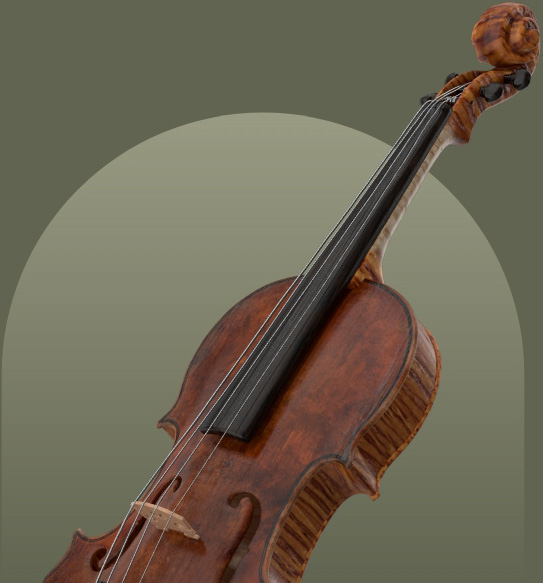
Francois Feury was a Parisian luthier active from approximately 1718 to 1762, known for his work as a pupil and son-in-law of Leclerc and for J. Ouvrard. He achieved the status of a sworn master of the Parisian lute makers' guild in 1752 and 1757. Feury crafted violins on a small Amatisé pattern, characterized by nicely proportioned forms, small and well-cut F-holes, a graceful scroll, and a distinctive thick, red varnish. Beyond violins, he produced double basses, vielles, guitars, mandolins, and, according to some accounts, wind instruments. His instruments, including a guitar converted into a hurdy-gurdy, are found in notable collections such as the Snoeck Collection in Berlin.
Maker Overview
Life
Francois Feury (c. 1718-1762) was a Parisian luthier active from approximately 1718 to 1762. He was a relative and pupil of Leclerc, whose daughter he married, making him Leclerc's son-in-law. Feury also worked for J. Ouvrard., he was a sworn master of the Parisian lute makers' guild in both 1752 and 1757. His workshop locations included rue de l'Arbre-Sec and rue des Fosses, St-Germain-l'Auxerrois, near rue de l'Arbre-Sec, as noted in various sources including Cecie Stainer and John Dilworth.
Characteristics
- Pattern
- His violins are generally described as being of a small pattern, specifically an Amatisé pattern.
- Workmanship
- Instruments are noted for being nicely proportioned, though Dilworth observes a somewhat coarse finish. Cecie Stainer, however, describes his work as good for the period, while Willibald Leo Lütgendorff mentions them as "hübsch gebaut" (prettily built).
- Varnish
- A consistent characteristic is a substantial, thick red varnish, which Dilworth also describes as a little hard.
- Sound-holes and Scroll
- Lütgendorff highlights beautifully cut small F-holes and a graceful scroll, a detail who notes small and well-cut sound-holes.
- Instrument Variety
- Feury crafted a range of instruments beyond violins, including double basses, vielles, and various plucked instruments such as guitars and mandolins. Cecie Stainer also mentions that he devoted much of his time to making wind instruments.
- Sometimes branded: ‘F. Feury à Paris’ F. Feury, rue de l’Arbre-Sec
vis-à-vis Saint-Germain-l’Auxerrois
Paris. 1753John Dilworth - F. Feury, rue des Fosses
St. Germain-de-la-Auxerrois proche la rue de l’Arbre-
sec.à Paris 17..John Dilworth
Influence and legacy
- Mentorship: Francois Feury was a pupil and relative of Leclerc, later becoming his son-in-law.
- Collaborations: He also worked for J. Ouvrard.
- Collections: A guitar by Feury, converted into a hurdy-gurdy, is part of the Snoeck Collection (No. 600) in Berlin, as documented by Willibald Leo Lütgendorff.
- Notable Owners: A. Rogat is known to possess a bass crafted by Feury.
Biographies
The overview above is drawn from the following published accounts. Read them in the original:
John Dilworth+
FEURY, François Worked circa. 1718-1762 Paris France. Relative and pupil of Leclerc, also worked for J. Ouvrard. Small Amatisé pattern, nicely proportioned but a little coarse in finish. Substantial red varnish; a little hard. Also made double basses, vielles, and plucked instruments. Sometimes branded: ‘F. Feury à Paris’ F. Feury, rue de l’Arbre-Sec / vis-à-vis Saint-Germain-l’Auxerrois / Paris. 1753 F. Feury, rue des Fosses / St. Germain-de-la-Auxerrois proche la rue de l’Arbre- / sec.à Paris 17.. [Milliot]
Cecie Stainer+
Son-in-law of Leclerc the violin maker. Was working at rue de l’Arbre sec, Paris, about 1750-60. His violins are on a small pattern, the sound-holes are small and well-cut, the varnish is a thick red, the work is good for the period. A guitar and a double-bass of his have been seen, but he devoted most of his time to making wind instruments.
and ” F. Feury, rue de Fosses, St-Germain-l’Auxerrois proche la rue de I’Arbre-sec a Paris, 17—.”
Willibald Leo Lütgendorff+
Schwiegersohn von Leclerc, geschworener Meister der Pariser Lautenmacherzunft
für 1752 und für 1757. Seine Geigen haben kleines Patron, sind hübsch gebaut, haben schöngeschnittene kleine F-Löcher, zierliche Schnecke. Sein Lack ist roth und dick. Er machte auch Guitarren, Mandolinen und Bässe. Eine zur Bauernleier umgebaute Guitarre befindet sich aus der Sammlung
Snoeck (No. 600) in Berlin. Einen Bass besitzt A. Rogat.
Sell your instrument with Amati
Get started by uploading photos of your instrument for our experts to review.
Sell your instrument with Amati
Get started by uploading photos of your instrument for our experts to review.
Working in Paris at the same time
Ambroise worked 1750–1810
Andrea Castagneri worked 1730–1762
Barbey worked 1720–1748
Benoist Flette worked 1755–1788
Benoit Fleury worked 1750–1792