
Italy School
Francesco Gobetti
Udine, Venice, 1675–1723
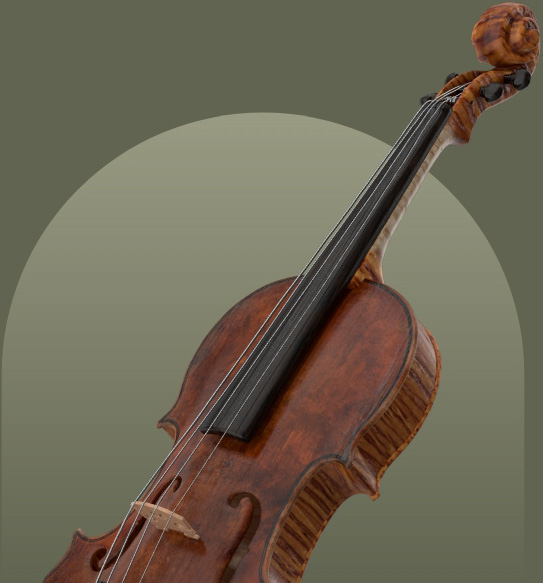
Francesco Gobetti (1675-1723) was a highly regarded Venetian luthier, initially recorded as a shoemaker, who became active in Venice around 1690. He is believed to have been a pupil of Matteo Gofriller, and possibly Antonio Stradivari, with his work often showing Cremonese influences. His instruments, produced primarily between 1710 and 1722, are noted for their remarkable copies of Stradivari, Amatisé, and Stainer models, often featuring rich, transparent varnishes in golden-yellow or dark wine-red hues. While his scrolls sometimes exhibit a weaker character, his overall workmanship is praised for its refinement and neat execution, and his selection of beautiful wood is consistently highlighted. Gobetti's violins are much liked for their rich, sweet tone and are considered among the finest of the Venetian school.
Auction price history
Highest auction price
| Type | Details | Sold | Price |
|---|---|---|---|
| Violin | Labelled Petrus Guarnerius Filius Joseph Cremonensis fecit Venetiis Anno 1739 | March 2024 | £102,000 |
| Violin | May 2013 | £18,750 | |
| Violin | 35.7 cm Venice, 1720 c. | October 2008 | £57,846 |
| Violin | 1715 | November 2000 | £55,700 |
| Violin | 1717 | March 1995 | £65,300 |
| Violin | 1710 c. | June 1991 | £55,000 |
| Violin | 1714 c. | March 1991 | £22,000 |
| Violin | 1710 c. | June 1990 | £7,920 |
| Violin | 1714 c. | November 1988 | £18,150 |
Maker Overview
Life
Francesco Gobetti (1675-1723) was born in Udine and later died in Venice, Italy. He is recorded as a shoemaker upon his first appearance in Venice around 1690, residing in the same parish as Matteo Gofriller. His own labelled work is documented from 1710 to 1722, a period during which he produced remarkable instruments. However, sources contain conflicting information regarding his working period; Willibald Leo Lütgendorff suggests a timeframe of 1690 to 1725, but notes that he has not encountered instruments dated before the 18th century, while also mentioning a violin in St. Florian, Upper Austria, bearing the date 1761, with a caveat about the legibility of the '6' as a '0'. George Hart notes that Gobetti is one of the little-known makers, attributing this to the historical practice of replacing original labels with those of more familiar makers. Hart argues that had Gobetti's name remained on his instruments, they would be as highly valued as any from the Venetian school, with the exception of Domenico Montagnana. A very beautiful violin by Gobetti, featuring fine golden-red varnish, was exhibited in Paris in 1878, bearing the label "Franciscus Gobetti, fecit Venetiis, 1715", with a similar label dated 1705 also noted by Cecie Stainer.
Characteristics
- Models
- Within his working period, Francesco Gobetti produced remarkable copies of Stradivari, among the first to appear, and also worked on Amatisé and Stainer models. Some of his late Stainer models exhibit very full arching, while others show refined workmanship with exaggerated Stainer mannerisms. His violins, characterized by a broad, flat pattern, recall early works of Stradivari and strike a balance between the Stradivari and Amati models, yet distinctly bear his personal stamp.
- Varnish
- Dilworth describes his varnish as rich golden-yellow on some instruments, and a complex dark wine-red laid over a typically Venetian vivid golden ground on his Stradivari types. Cecie Stainer notes his use of very beautiful red varnish, which is rather transparent. Willibald Leo Lütgendorff states that his varnish, originally quite red, now appears as a clear, pale red color. George Hart describes the varnish as equal to any from the Venetian school, second only to Cremona, generally being a pale red of considerable transparency.
- Workmanship
- His workmanship is described as very fine and versatile by John Dilworth, with some pieces showing very refined execution. Cecie Stainer highlights the careful finish throughout his work. Willibald Leo Lütgendorff notes his careful craftsmanship. George Hart praises the uniformly neat execution of his work.
- Archings
- Some of his late Stainer models feature very full arching, while his Stradivari types show only a slight tendency towards a pinched arch, as detailed by John Dilworth. His violins are generally of a broad, flat pattern.
- Soundholes
- The Stradivari types exhibit slightly close-set soundholes. Cecie Stainer and Willibald Leo Lütgendorff note that his F-holes are similar to those of Ruggeri. George Hart also observes a slight likeness in the soundhole to the work of Francesco Ruggeri.
- Scrolls
- John Dilworth states that his scrolls are very well carved, accurately concentric, and feature a very even, well-regulated chamfer, making them more precise than those of most other Venetian makers. In contrast, Cecie Stainer describes the scroll as rather weak in character. Willibald Leo Lütgendorff considers the curve of the scroll less successful, and George Hart also finds the scroll to be the least successful part, being weak in character compared to the body.
- Purfling
- Cecie Stainer notes that the purfling on his instruments is not very neat.
- Wood
- He used splendid wood, and very beautiful wood. George Hart emphasizes that the wood used is most handsome, noting that Venetian makers were adept at selecting beautiful wood, making it rare to find a Venetian instrument with plain wood.
- Tone
- Cecie Stainer describes the tone as having a rich full quality. George Hart characterizes the tone of Gobetti's works as round, without great power, but possessing a singularly sweet quality.
- Franciscus Gobetti
fecit Venetiis, 1722John Dilworth
Influence and legacy
- Mentorship: John Dilworth records that Francesco Gobetti lived in the same parish as Matteo Gofriller and was probably a pupil of his, alongside Domenico Montagnana. However, Cecie Stainer, Willibald Leo Lütgendorff, and George Hart all state that he is considered to have been a pupil of Antonio Stradivari, with Hart adding that this is "possibly with some reason" due to the similarity of his instruments to the great master's early works.
- School:, his work places him within the Cremonese school. George Hart also notes that Gobetti's style is superior, being more Cremonese than Venetian.
- Reputation: His instruments are much liked. George Hart places Gobetti in a prominent position within the Venetian school, stating that his style is superior and his model preferable when compared to Santo Serafino.
- Collections & Exhibitions: A very beautiful violin by Gobetti was exhibited in Paris in 1878. Willibald Leo Lütgendorff mentions that a particularly beautiful violin by him was part of the Wilmotte collection in Antwerp.
Biographies
The overview above is drawn from the following published accounts. Read them in the original:
John Dilworth+
GOBETTI, Francesco Born 1675 Udine, died 1723 Venice Italy. Very fine and versatile maker. Recorded as a shoemaker in his first appearance in Venice around 1690. Lived in the same parish as Matteo Gofriller, and was probably a pupil of his, alongside Domenico Montagnana. Own labelled work appears from 1710 to 1722. Within this short working period produced some remarkable copies of Stradivari, amongst the first to appear anywhere, but also worked on Amatisé and Stainer models. Some of the late Stainer models appear rather coarse, with very full arching, but others show very refined workmanship, if a little exaggerated in the Stainer mannerisms, with rich golden-yellow varnish. This work bears some resemblance to that of Carlo Tononi, who was active in Venice from c.1715. The Stradivari types are extremely well-made, with only a slight tendency towards a pinched arch and slightly close-set soundholes, but the complex dark wine-red varnish is superb, laid over a typically Venetian vivid golden ground. In general the scrolls are very well carved, accurately concentric, and with a very even well-regulated chamfer; far more precise than those of most other Venetian makers. Franciscus Gobetti / fecit Venetiis, 1722
George Hart+
This is one of the little-known makers, a fact which may be attributed to the practice common some years ago of removing the original label of an instrument and substituting another, bearing a name more likely from its familiarity to command attention.
When we see Violins bearing the stamp of genius upon them, and reflecting much credit on the maker, the lovers of the instruments cannot but regret that the author should have been eclipsed, and deprived of his just praise. Had the name of Gobetti been permitted to associate itself with the instruments into which it was originally placed, they would have been as highly valued as any belonging to the Venetian school, with the single exception of Domenico Montagnana. The admirers of that finished maker, Santo Serafino, may perhaps dispute the justice of this observation ; but, having carefully weighed the merits of both Santo Serafino and Gobetti, I have no hesitation in awarding to the latter the foremost place. Gobetti’s style is superior, being more Cremonese than Venetian ; and further, his model is preferable.
Gobetti has been considered to have been a pupil of Antonio Stradivari, possibly with some reason, for his instruments bear a similarity to the early works of the great master. The instruments of this maker, like those of many others of his class, have passed for the works of Ruggeri, and sometimes of Amati. There is a slight likeness about the soundhole to the work of Francesco Ruggeri; but to the skilled in such matters, no feature interchangeable with Amati can be detected.
The workmanship has a uniformly neat execution; the scroll is the least successful part, being weak in character as compared with the body. The varnish is equal to any belonging to the Venetian school, and its beauty is second only to that of Cremona; its colour is generally a pale red, of considerable transparency. The wood is most handsome. These Venetians were not a little happy in selecting beautiful wood; in fact, it is scarcely possible to discover a single Venetian instrument the wood of which is plain. The tone of Gobetti’s works is round, without great power; but the quality is singularly sweet.
Cecie Stainer+
A maker at Venice about 1705. Said to have been a pupil of Antonio Stradivari; he used splendid wood, very beautiful red varnish, rather transparent, and made on a large flat pattern, with sound-holes similar to those of Ruggeri; the purfling is not very neat, and the scroll is rather weak in character; but the workmanship throughout is carefully finished and the tone is of a rich full quality.
A very beautiful violin was exhibited in Paris, 1878, with fine golden-red varnish, with label : ” Franciscus Gobetti, fecit Venetiis, 1715.” A similar label has been seen dated 1705. His instruments are much liked.
Willibald Leo Lütgendorff+
Nach seiner Arbeit gehört er zur Cremoneser Schule. Viele machen ihn
sogar zu einem persönlichen Schüler Stradivari’s. Er ist nächst Montagnano
und Serafino Santo der bedeutendste Venetianer Geigenmacher. Als seine
Arbeitszeit wird gewöhnlich der Zeitraum von 1690—1725 angegeben; ich halte
die Zahlen für ungenau, da mir Geigen mit einem vor dem 18. Jahrhundert
liegenden Datum von Gobetti nie vorgekommen sind; im Stifte St. Florian in
Oberösterreich befindet sich dagegen eine Violine von ihm, auf der die Jahreszahl 1761 zu lesen ist, — wenn die 6 nicht als 0 gelesen werden muss. — Seine Geigen, von breitem, flachgewölbtem Patron, erinnern an frühe Arbeiten Stradivari’s und halten zwischen dem Stradivari- und Amati- Modell die Mitte, doch wusste er dabei seinen
Violinen durchaus den Stempel seiner Eigenart aufzudrücken. Er verwandte sehr schönes Holz, war sorgfältig in der Arbeit, seine F-Löcher sind denen Ruggeri’s ähnlich, weniger gelungen ist ihm der Schwung der Schnecke. Sein Lack, der ursprünglich ganz roth gewesen sein muss, erscheint jetzt von klarer, blassrother Farbe. Eine besonders schöne Geige von ihm befand sich in der Sammlung Wilmotte in Antwerpen.
Sell your instrument with Amati
Get started by uploading photos of your instrument for our experts to review.
Sell your instrument with Amati
Get started by uploading photos of your instrument for our experts to review.
Working in Udine at the same time
Antonio Molinari worked 1672–1703
Antonio Pandolfi worked 1715–1742
Carlo Tononi 1675–1730
Castro worked 1684
Domenico Montagnana 1687–1750
Francesco Goffriller 1692–1740
Frederico Mezzano worked 1695
Luigi Bodeni worked 1719