
Italy School
Matteo Goffriller
Bressanone, Venice, c.1659–1742
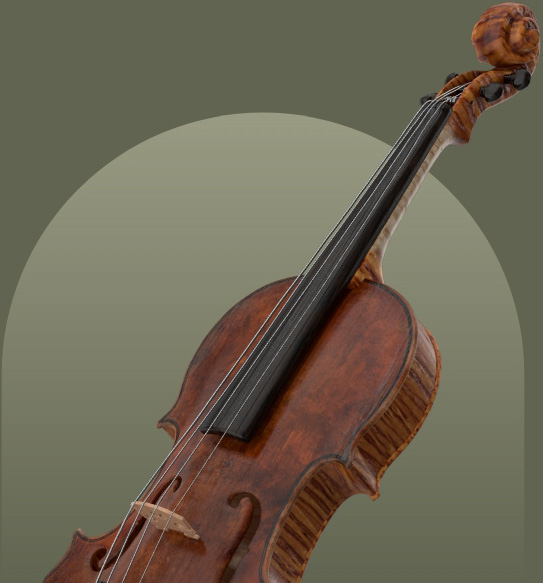
Matteo Goffriller (1659-1742) was a pivotal figure in Venetian violin making, recognized as the founder of the 18th-century Venetian school. Arriving in Venice in 1685, he became the city's premier violin maker, known for his distinctive instruments, particularly his celebrated cellos. His work, while showing Cremonese influence, developed a unique style characterized by a deep red-brown varnish and powerful tone. He is presumed to have taught several notable makers, including Domenico Montagnana.
Auction price history
Highest auction price
| Type | Details | Sold | Price |
|---|---|---|---|
| Violin | 35.4 cm Venice, 1692 | March 2010 | £144,000 |
| Violin | 35.7 cm Venedig, 1710 c. | November 2008 | £181,607 |
| Violin | 35.1 cm Venice, 1705 | April 2008 | £132,852 |
| Violin | 35.5 cm [Ascribed to] | October 2007 | £9,833 |
| Violin | 35.1 cm 1700 c. [Probably by] | May 2006 | £10,424 |
| Cello | Venice, 1707 c. (later scroll), with Provenance | April 2005 | £324,161 |
| Violin | 1700 c. [Attributed] | March 2004 | £33,600 |
| Violin | 1710 | November 1997 | £45,500 |
| Violin | 1706 c. | March 1994 | £65,300 |
| Violin | 1727 | June 1993 | £55,400 |
| Violin | March 1993 | £67,500 | |
| Violin | 1703 | November 1991 | £90,200 |
| Violin | 1695 c. | November 1989 | £38,500 |
| Violin | 1700 c. | November 1988 | £44,000 |
| Cello | 1705 | June 1988 | £88,000 |
| Cello | 1700 c. | November 1987 | £45,100 |
| Violin | 1735 | November 1982 | £13,200 |
| Cello | 1700 c. | May 1980 | £30,800 |
Maker Overview
Life
Matteo Goffriller (1659-1742) was born circa 1659 in Bressanone and died in 1742 in Venice, Italy.'s The Brompton's Book of Violin & Bow Makers, Goffriller arrived in Venice in 1685 to work for Martin Kaiser, whose son-in-law he subsequently became. He succeeded to the workshop in 1690, establishing himself as the premier violin maker in the city. Dilworth identifies him as the first specialist violin maker there, as far as can be presently determined, and credits him as the founder of the remarkable 18th-century Venetian school.
Characteristics
- Style & Influence
- Goffriller's work covers a variety of styles, clearly showing a strong influence of Cremona in his rather impressionistic copies of Stradivari and Amati.
- Workmanship
- His workmanship is consistently described as accurate and skillful by Cecie Stainer in A Dictionary of Violin Makers, of a good kind by George Hart in The Violin, and exemplary by Willibald Leo Lütgendorff in Die Geigen- und Lautenmacher vom Mittelalter bis zur Gegenwart.
- Wood Selection
- Sources contain conflicting information regarding Goffriller's choice of wood. While George Hart states that the wood was usually of good quality, Cecie Stainer and Willibald Leo Lütgendorff note that he was often careless about his material, with several violoncellos having backs made of poplar wood.
- Arch & Proportions
- Sources also present varying descriptions of his arching. Cecie Stainer describes his pattern as slightly arched, while John Dilworth notes that his celebrated cellos typically feature a low and powerful arch and broad breast. Willibald Leo Lütgendorff suggests his violins' arching is more reminiscent of the Tyrolean school than the Italian.
- Scroll
- A consistent feature of his work is a small, quickly cut scroll with a slight upright ovality. Willibald Leo Lütgendorff describes the scroll as deep and sweeping.
- Sound-holes
- The sound-holes are described as well cut by Cecie Stainer and the F-holes as good by Willibald Leo Lütgendorff.
- Varnish
- John Dilworth describes his varnish as a deep red-brown, sometimes applied thin with great intensity, and at other times built up to a thick, crackled texture. Cecie Stainer mentions a golden-yellow, very transparent varnish. Willibald Leo Lütgendorff notes his particularly beautiful red, red-brown, or yellow-brown lacquer.
- Tone
- His instruments are known for their powerful and even tone quality, and a very noble tone.
- Models
- Goffriller produced several violas of contralto size, characterized by a distinct and original narrow model with a long stop. His cellos are most celebrated, establishing the particular reputation for Venetian cellos in general. These are usually of large size, though several smaller cellos with a back length around 70 cm (27½") also exist.
- Mattio Goffriller
Fece in Venezia. Anno 1709John Dilworth - Matteo Goffriller
fecit Venetijis. anno 1724John Dilworth
Influence and legacy
- Mentorship: Matteo Goffriller is presumed to have been the teacher of Domenico Montagnana, Francesco Gobetti, and his son Francesco.
- Reputation: His cellos are particularly celebrated and established the reputation for Venetian cellos in general.
- Notable Instruments: A particularly fine example of his cellos, used by Pablo Casals, was previously attributed to Bergonzi.
- Label Inscriptions: Examples of his labels include "Mattio Goffriller / Fece in Venezia. Anno 1709" and "Matteo Goffriller / fecit Venetijis. anno 1724".
Biographies
The overview above is drawn from the following published accounts. Read them in the original:
John Dilworth+
GOFFRILLER, Matteo Born circa. 1659 Bressanone, died 1742 Venice Italy. Gofriller arrived in Venice in 1685 to work for Martin Kaiser, whose son-in-law he subsequently became. He succeeded to the workshop in 1690, and became the premier violin maker in the city; the first specialist violin maker there, as far as can be presently determined, and the founder of the remarkable 18th century Venetian school. He is presumed to have been the teacher of Domenico Montagnana, Francesco Gobetti, and his son Francesco. His work covers a variety of styles and clearly shows the strong influence of Cremona in his rather impressionistic copies of Stradivari and Amati. His small quickly cut scroll with a slight upright ovality is one constant. Another is the deep red-brown varnish, sometimes applied thin but with great intensity; at other times built up to a thick, crackled texture. Several violas are known, of contralto size, and of a distinct and original narrow model with a long stop. Most celebrated are his cellos which established the particular reputation for Venetian cellos in general. A particularly fine example used by Pablo Casals was previously attributed to Bergonzi. Usually of large size, they are important in having a low and powerful arch and broad breast. Most have been subsequently been cut down for modern use, but there also exist several smaller size cellos with a back length around 70 cm (271/2”). Mattio Goffriller / Fece in Venezia. Anno 1709 Matteo Goffriller / fecit Venetijis. anno 1724
George Hart+
The workmanship is usually of a good kind, and the wood of good quality. The style is, however, different to that we are accustomed to associate with Italy.
Cecie Stainer+
A maker in Venice about 1690 to 1740. He had great ability, and his work is peculiarly beautiful and original ; his pattern is slightly arched, the sound-hole well cut, the golden-yellow varnish very transparent. It is the exception to find violins and violoncellos in which the wood was carefully chosen ; as a rule he was careless about his material, several violoncellos have the back made of poplar tree wood ; but the same accurate and skilful workmanship is always shown ; the tone was powerful and even in quality. His whole work, in arching, proportions, and varnish, is so unlike that of Stradivari that it is absurd to insert Stradivari labels into his instruments. His violoncellos are especially liked, two being known, most beautifully made.
Willibald Leo Lütgendorff+
Wahrscheinlich ein Tyroler aus Lajen, der wohl auch in seiner Heimath gelernt
hat, wesshalb seine Geigen in der Wölbung auch mehr an die Tyroler als an
die italienische Schule erinnern. Seine Arbeit ist musterhaft, nur in der Wahl des
Holzes ist er nicht immer sorgfältig, neben schönen, feinjährigen Decken kommen
auch recht unschöne vor, der Boden ist meist nach der Schwarte geschnitten,
bei seinen Violoncelli oft nur aus Pappelholz. Die F-Löcher sind gut, die
Schnecke tief und schwungvoll gestochen. Besonders schön ist sein rother, rothbrauner oder gelbbrauner Lack. Der Ton ist sehr edel, so dass manche Händler,
die wenig Verständniss haben, Geigen von ihm für Werke von Stradivari ausgeben
wollen, was bei der auffälligen Verschiedenheit des Modells kaum zu
verstehen ist; begreiflicher ist es dagegen, dass seine Violoncelli für Arbeiten
Sell your instrument with Amati
Get started by uploading photos of your instrument for our experts to review.
Sell your instrument with Amati
Get started by uploading photos of your instrument for our experts to review.
Working in Bressanone at the same time
Antonio Molinari worked 1672–1703
Antonio Pandolfi worked 1715–1742
Carlo Mondi worked 1654
Carlo Tononi 1675–1730
Castro worked 1684
Cristoforo Cecco worked 1665
Domenico Busan 1720–1783
Domenico Montagnana 1687–1750