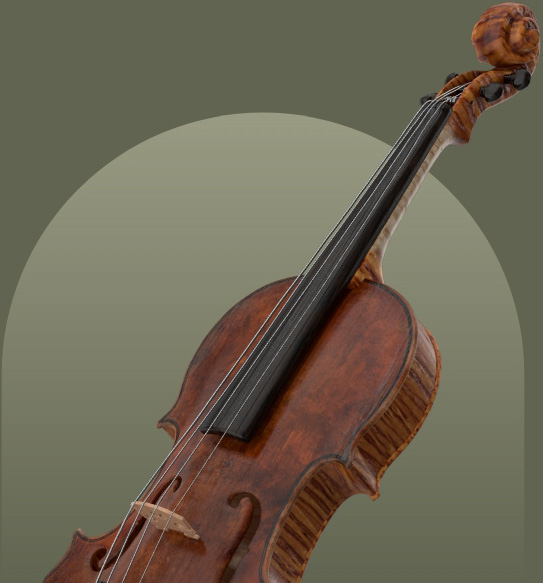
Andrea Guarneri
Auction price history
Highest auction price
£259,147
| Type | Details | Sold | Price |
|---|---|---|---|
| Violin | Ex Alice Schoenfeld, labelled Andrea Guarnerius fecit Cremone sub titulo Sanctae Teresia 1676 | May 2024 | £259,147 |
| Violin | May 2014 | £68,500 | |
| Violin | October 2011 | £12,500 | |
| Violin | 35.8 cm [Ascribed to] | October 2011 | £12,500 |
| Violin | 35.2 cm Late 17th C. [Attributed to] | October 2010 | £24,409 |
| Violin | 35.1 cm Cremona, 1680 c. (dimentions altered) | October 2010 | £87,000 |
| Violin | 35.3 cm Cremona, 1695 | November 2008 | £95,793 |
| Violin | 35.1 cm 18th C. [Ascribed to] | October 2008 | £12,500 |
| Violin | 35.3 cm Cremona, 1690 c. | October 2007 | £59,489 |
| Violin | 35.3 cm Cremona, 1680 c. | November 2006 | £126,046 |
| Violin | 35.9 cm Cremona, 1710 c. | November 2006 | £229,600 |
| Violin | Italy, 1680 c. | November 2005 | £38,400 |
| Violin | Cremona, 1687 | October 2005 | £115,404 |
| Violin | Cremona, 1670 c. [Table by Gagliano family] | July 2004 | £48,000 |
| Violin | 1675 (composite) | October 2001 | £39,007 |
| Violin | 1673 | November 1999 | £87,300 |
| Violin | 1677 | November 1998 | £89,500 |
| Violin | 1645 c. | March 1998 | £63,100 |
| Violin | 1676 | November 1992 | £137,500 |
| Violin | 1698 | November 1991 | £28,600 |
| Violin | 1674 c. | June 1991 | £39,600 |
| Violin | November 1990 | £16,500 | |
| Violin | 1679 | March 1990 | £33,000 |
| Cello | 1697 | June 1989 | £121,000 |
| Violin | 1662 | June 1989 | £126,500 |
| Violin | 1655 | November 1988 | £93,500 |
| Violin | 1694 | May 1986 | £34,100 |
| Violin | 1656 | May 1981 | £12,100 |
Instruments

Maker Overview
History
Andrea Guarneri (1623 or c. 1626 – 1698), son of Bartolommeo, was the progenitor of the renowned Cremonese violin-making family, the Guarnerius. Sources contain conflicting information regarding his birth year, with John Dilworth stating 1623, while Cecie Stainer and Willibald Leo Lütgendorff's account of him being 15 years old in 1641 suggests circa 1626. He was born and died in Cremona, Italy, and was buried in the Church of San Domenico on December 8, 1698.
Andrea Guarneri was the first apprentice of Nicolò Amati, beginning around 1640. He resided in the Amati household until 1646 and returned between 1650 and 1653. According to Lütgendorff, he is mentioned in the records of the parish of St. Faustino and Giovita in 1641 as a co-resident of the Amati house. Amati held him in high regard, choosing him as a witness for his marriage to Lucrezia Pagliari on May 23, 1645. On December 31, 1652, Andrea Guarneri married Anna Maria Orcelli (who died on January 13, 1695) in the Church of San Clemente. This marriage produced seven children, including four daughters and three sons.
After his apprenticeship, Andrea Guarneri established his own workshop in the Piazza San Domenico, now known as Piazza Roma. This was the first significant violin-making shop in Cremona outside of the Amati atelier. His workshop was identified by the sign of St. Theresa, which also appeared on his labels. His eldest son, Pietro, later moved to Mantua, while his younger son, Giuseppe, became his assistant and successor. Through his sons, Andrea's influence on the trajectory of violin making became immensely significant.
Craft
- General Character: Andrea Guarneri's work possesses great character and is closely allied to the Amati form. While it may lack the perfection of Amati's execution, certain touches give it immediate distinction.
- Arching: The arch is generally rather pinched, though later models show a flatter arching. The pattern is slightly arched.
- Purfling: The purfling points are strongly deflected across the corners.
- Scroll: The eye of the scroll has a heavy tail leading into the first turn. Later, the scroll showed signs of originality and much character.
- Varnish: His varnish is described as a rich golden amber, or a light orange color of beautiful hue. It varied greatly in color, from golden yellow to orange, or even darker rose color. It sometimes had considerable body but could lack the transparency of lighter varnishes.
- Sound-holes: The F-holes were changed over time, and the sound-holes generally vary but are often straight.
- Instrument Models: Andrea Guarneri initially adhered closely to his teacher's models, but later his violins became larger than those of his teacher. He developed his own scroll and changed the F-holes.
- Violas: His contralto violas are considered the first great instruments of their type from Cremona. Three violas are known, suggesting Maggini's work in size and general style.
- Cellos: His cellos, built on a highly arched and voluptuous model, are of very great importance. He made violoncellos in two sizes, often using plain wood that possessed singular tone-producing qualities.
- Violins: His violins are among his finest efforts, with excellent workmanship, though not possessing the fine finish of Amati. Violins in good condition are very rare.
- Tone: The tone is generally good, and his violoncellos are particularly well-regarded. The tone of his violins is described as brilliant but not carrying well.
- Workmanship: The work is neat but not highly finished.
- Wood: He generally used good wood.
- Other Instruments: Besides full-sized violins, he also crafted “halbe” (half) violins.
Influence
- Mentorship: Andrea Guarneri was the first apprentice of Nicolò Amati, beginning around 1640. He lived in the Amati house during his apprenticeship.
- Fellow Students: He was a fellow student of Antonio Stradivari in the workshop of their common master, Niccolò Amati.
- Stylistic Influence: He was initially influenced by Antonio and Girolamo Amati, making instruments on a large pattern, and then for many years followed Nicolò Amati's pattern. Around 1670, the influence of Stradivari began to be felt, and Andrea Guarneri became one of Stradivari's earliest followers, though he always retained an original and distinctive style.
Legacy
- Family Dynasty: Andrea Guarneri was the head and patriarch of the celebrated Guarnerius family of violin makers.
- Succession: His younger son, Giuseppe Giovan Battista, became his assistant and successor in the workshop.
- Continuity: Two of his sons, Pietro Giovanni and Giuseppe Giovan Battista, also became violin makers, ensuring the continuation of the family's legacy.
- Historical Significance: Andrea Guarneri is recognized as the pioneer of the Guarneri family, and his influence was crucial for the later extraordinary works of his nephew, Giuseppe Guarneri “del Gesù.”
Further Information
- Workshop Location: His workshop was located in the Piazza San Domenico, now known as Piazza Roma, in Cremona.
- Workshop Sign: The workshop was identified by the sign of St. Theresa.
- Labels: Examples of his labels include: “Andreas Guarnerius Cremonae sub / titulo Sanctae Teresia. 16..”; “Andreas Guarnerius fecit Cremonen sub titulo Sanctae Teresiae, 1650” (similar labels are dated 1670, 1675, 1690, and 1696); and “Sub disciplina, Andreae Guarnerii in ejus officina sub titulo S. Teresiae Cremonae, 1676.”
- Notable Instruments: The Royal Collection of Old Musical Instruments in Berlin possesses a “halbe” (half) violin made by Andrea Guarneri from the year 1644.
Biographies
John Dilworth
GUARNERIUS, Andrea Born 1623, died 1698 Cremona Italy. First apprentice of Nicolò Amati from c.1640. He lived in the Amati house until 1646, but returned 1650-1653, before establishing his own workshop in the Piazza San Domenico, the first significant violin making shop in the city other than the Amati atelier. It was identified by the sign of St Theresa which also appears on his labels. His eldest son, Pietro, moved to Mantua, but the younger, Giuseppe, became his assistant and successor. Through them Andrea’s influence on the course of violin making became enormously important. His own work is possessed of great character and is closely allied to the Amati form. In execution it lacks the perfection of Amati, but certain touches give it immediate distinction. The arch is generally rather pinched, the purfling points strongly deflected across the corners, and the eye of the scroll has a heavy tail leading into the first turn. His varnish is a rich golden amber. Perhaps his most important work is in the development of the viola and cello. Contralto violas from his hand are the first great instruments of their type from Cremona, and his cellos, built on a highly arched and voluptuous model, are also of very great importance. Andreas Guarnerius Cremonae sub / titulo Sanctae Teresia. 16..
Sell your instrument with Amati
Get started by uploading photos of your instrument for our experts to review.
Sell your instrument with Amati
Get started by uploading photos of your instrument for our experts to review.