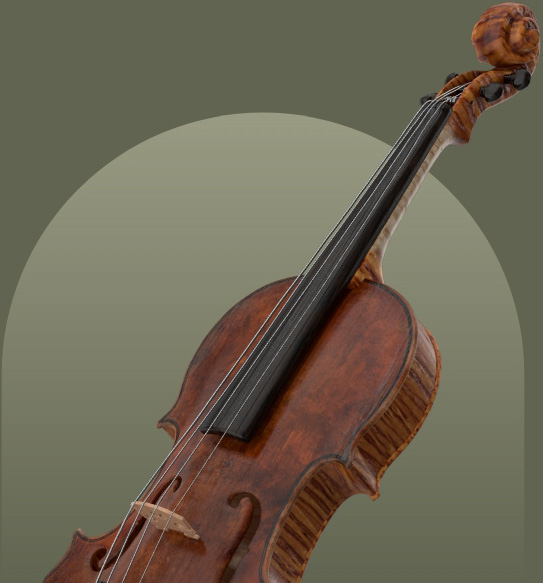
Henry (I) Jay
Southwark, worked 1585–1667
Henry (I) Jay (circa. 1585-1667) was a highly esteemed early English viol maker who worked in Southwark, London. Recognized by contemporaries like Thomas Mace and Thomas Britton for the excellent quality and fine tone of his instruments, Jay's viols were considered among the best of his era. He was a Freeman of the Fletcher's company in 1606. Several of his instruments, including bass and tenor viols, are preserved in prominent collections such as the Victoria and Albert Museum, the Gemeente Museum, The Hague, the Royal College of Music, London, and the Paris Conservatoire Collection.
Maker Overview
Life
Henry (I) Jay (circa. 1585-1667) worked in Southwark, London, UK, from approximately 1585 to 1667. Both spellings of his name, Jay and Jaye, are found on labels and in historical texts. He was an important early English viol maker, and his instruments were particularly prized throughout Europe during his time in his Musick's Monument (1676). Henry Jay was made a Freeman of the Fletcher's company in 1606, an organization to which other notable makers like Richard Meares and William Baker also belonged. Thomas Mace's Musick's Monument (published 1676) states, "Your best provision (and most compleat) will be a good chest of viols... of such there are no better in the world than those of Aldred, Jay.... these were old.... yet we chiefly value Old Instruments before new; for by experience they are found to be far the best." Thomas Britton's Catalogue of Musical Instruments also refers to him, mentioning "a viol said to be the neatest and best that Jay ever made."
Characteristics
- Instrument Type
- Henry Jay was primarily a maker of viols, including bass viols and tenor viols. One of his viols was converted into a small violoncello with four strings.
- Workmanship
- His work is considered excellent, characterized by fine tone, good quality varnish, well-cut heads, and very fine purfling. William Meredith Morris notes his work is "considered excellent."
- Specific Instruments
- Several of his viols are extant. An excellently made viol, converted into a small violoncello, was dated "in Southwarke, 1615." A small bass-viol dated 1624 is part of the Paris Conservatoire Collection (No. 171). A tenor viol, exhibited at the South Kensington Museum, London, in 1872, featured six strings, catgut frets, and a beautifully carved scroll. A finely decorated bass viol is currently held in the Royal College of Music, London, as part of the Kessler collection.
Influence and legacy
- Museum Collections: Henry Jay's instruments are preserved in significant collections. One viol was formerly in the Victoria and Albert Museum, another is in the Gemeente Museum, The Hague, and a bass viol is in the Royal College of Music, London. The Paris Conservatoire Collection also houses one of his bass viols.
- Historical Esteem: He was singled out by Thomas Mace as one of the best makers of his time, and his instruments were highly valued, with Mace stating there were "no better in the world" than those by makers like Jay.
Biographies
The overview above is drawn from the following published accounts. Read them in the original:
John Dilworth+
JAY (JAYE), Henry (I) Worked circa. 1585-1667 Southwark, London UK. Both spellings of the name found on labels and in texts. Important early English viol maker. Singled out by Mace in his Musick’s Monument (1676) as one of the best of his time when English viols were particularly prized throughout Europe. Made a Freeman of the Fletcher’s company in 1606, to which Richard Meares and William Baker also belonged. Several viols extant, one formerly in the Victoria and Albert museum, another in the Gemeente Museum, The Hague, and a finely decorated bass viol currently in the Royal College of Music, London (Kessler collection). Henry Jaye in Southwarke 1621
George Hart+
Maker of Viols, which are capital specimens of the work of the period. The varnish is excellent.
William Meredith Morris+
A maker of viols. His work is considered excellent, but I am not acquainted with it and cannot therefore offer any remarks.
Cecie Stainer+
A maker of viols in London about 1615-67. A viol, that had been converted into a small Violoncello with four strings, was excellently made and of fine tone, the varnish of good quality, the head well cut, the purfling very fine; it was dated “in Southwarke, 1615 ”
A small bass-viol dated 1624 is in the Paris Conservatoire Collection ; a tenor viol was exhibited at the South Kensington Museum, London, 1872, with the label ” Henry Jay in Southwarke, 1667.” It has six strings, tuned one-fifth higher than the bass-viol, catgut frets, and a beautifully carved scroll. It is probably this maker, alluded to in Thomas Britton’s Catalogue of Musical Instruments: “a viol said to be the neatest and best that Jay ever made.” This passage, from Thomas Mace’s ” Musick’s Monument ” (published 1676), also probably applies to him : ” Your best provision (and most compleat) will be a good chest of viols . . . of such there are no better in the world than those of Aldred, Jay . . . . these were old …. yet we chiefly value Old Instruments before new; for by experience they are found to be far the best.”
Willibald Leo Lütgendorff+
Einer der besten englischen Violen- und Lautenmacher seiner Zeit, von
dem sich einige wenige treffliche Instrumente erhalten haben: das älteste von
1615, das letzte von 1667. Eine Bassviole befindet sich im Museum des Pariser Conservatoriums (No.l71), eine Tenorviola war 1872 im South Kensington Museum ausgestellt Th. Mace erwähnt ihn rühmend in seinem »Musicks Monument (1676), Brittons Catalogue of Mus. Instr.« verweist gleichfalls auf ihn, und im Selhof’schen
Versteigerungskatalog (1759) wird eine Gamba von »Henr. Geaye Southwark London 1632« aufgeführt.
Sell your instrument with Amati
Get started by uploading photos of your instrument for our experts to review.
Sell your instrument with Amati
Get started by uploading photos of your instrument for our experts to review.