
Mittenwald School
Georg (I) Klotz
Mittenwald, 1687–1737
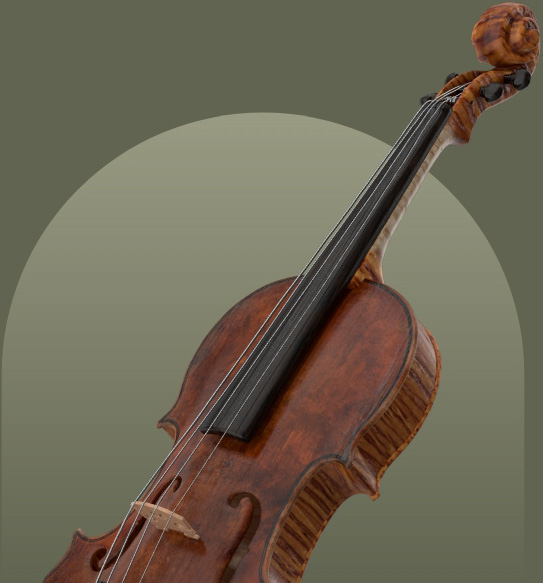
Georg (I) Klotz (1687-1737) was a prominent German luthier from Mittenwald, the son of the esteemed Matthias Klotz. Known for following the Stainer pattern, his instruments are characterized by a large model with medium arching and often feature distinctive carved lion heads. While his workmanship was generally considered good, sources frequently note the variable quality of his spirit varnish, which could be thin, brittle, and opaque, and his occasional use of wood prone to worm damage. Despite these material challenges, his instruments were well-finished and are preserved in numerous collections, including a viola d'amore in the Museum Kraus in Florence. His labels, sometimes handwritten, provide specific dates and locations of his work in Mittenwald.
Auction price history
Highest auction price
| Type | Details | Sold | Price |
|---|---|---|---|
| Violin | Bearing the maker's label, many cracks and restorations | December 2024 | £9,320 |
| Violin | 1737 | October 1995 | £3,450 |
| Violin | 1730 | June 1994 | £5,175 |
| Cello | 1725 c. | July 1993 | £8,050 |
| Violin | 1702 | July 1992 | £1,980 |
| Cello | 1734 | May 1980 | £1,100 |
Maker Overview
Life
Georg (I) Klotz was a member of the prominent Klotz family of violin makers., he was born in 1687 and died in 1737 in Mittenwald, Germany. However, Cecie Stainer states he was working in Mittenwald about 1750-80, indicating a discrepancy in the historical records regarding his active period. Lütgendorff identifies him as the son of Mathias Klotz from his first marriage. He was known in parish records as a “chelyfactor” and held the honorary position of “Marktverraithers” (market chamberlain). Georg (I) Klotz was married to Anna Sprenger, who passed away on December 6, 1734.
Characteristics
- Pattern and Model
- Georg (I) Klotz primarily followed the Stainer pattern. John Dilworth describes his instruments as having a large model with medium height arching.
- Workmanship
- His instruments were generally well made and characterized by clean execution. Stainer specifically mentions "beautifully finished work."
- Varnish
- The varnish used by Klotz is a notable characteristic, though often described with reservations. Cecie Stainer notes it as a spirit varnish, sometimes yellow, sometimes red, but of poor quality—thin, brittle, and laid on a coat of size, which prevented penetration into the wood, making it opaque and perishable. George Hart similarly describes the instruments as chiefly yellow in color. John Dilworth corroborates this, detailing a poor quality, thin, and brittle varnish laid over a fragile glue size in red or yellow tints. In contrast, Willibald Leo Lütgendorff praises his brown-yellow or red-brown lacquer.
- Wood Quality
- A recurring observation across sources is the quality of wood used. Cecie Stainer, George Hart, and Willibald Leo Lütgendorff all mention that the wood was often worm-eaten, with Lütgendorff noting that Klotz sometimes used inferior wood.
- Distinctive Features
- Many of his violins are distinguished by beautifully carved lion heads, a detail highlighted by both John Dilworth and Willibald Leo Lütgendorff.
- George Kloz in Mitten-
vvald an der Iser. 1737John Dilworth
Influence and legacy
- Family Lineage: Georg (I) Klotz was the son of Matthias Klotz, a foundational figure in the Mittenwald school of violin making, as confirmed by John Dilworth and Willibald Leo Lütgendorff. This familial connection suggests his training and early influences stemmed directly from his father's workshop and the established traditions of the Klotz family.
- Collections: Instruments crafted by Georg (I) Klotz are still found in many collections today, attesting to their enduring value and quality.
- Museum Holdings: A viola d'amore made by Georg (I) Klotz is preserved in the Museum Kraus in Florence, Italy.
Biographies
The overview above is drawn from the following published accounts. Read them in the original:
John Dilworth+
KLOTZ, Georg Born 1687, died 1737 Mittenwald Germany. Son of Matthias Klotz, above. Large model with medium height arching. Varnish of poor quality; thin and brittle, laid over a fragile glue size in red or yellow tints. Often with carved lion heads. Manuscript labels: George Kloz in Mitten- / vvald an der Iser. 1737 [Layer, Baader]
George Hart+
Brother of Sebastian Kloz. Instruments well made, chiefly yellow in colour ; wood often worm-eaten.
Cecie Stainer+
Another member of the Klotz family, was working in Mittenwald about 1750-80. He also followed the Stainer pattern. His instruments were well made, but the spirit varnish, sometimes yellow, sometimes red, is of bad quality; it is thin and brittle and laid on a coat of size which prevents its penetrating the wood, making it opaque and perishable ; the wood is often worm-eaten.
In a violin of beautifully finished work with red varnish was the label: ” George Klotz propria mea manu feci in Mittenwald, 1753″; another label was” George Klotz in der Mittenwald an der Iser, 1761.”
Willibald Leo Lütgendorff+
Sohn (erster Ehe) von Mathias Kl. In den Pfarrbüchern wird er »chelyfactor«
genannt und bekleidete das Ehrenamt eines »Marktverraithers« (Marktkämmerers)
Vermählt war er mit Anna geb. Sprenger († 6. Dec. 1734). Seine
Arbeit ist gut; auch sein braungelber oder rothbrauner Lack und der Ton seiner
Instrumente verdienen Lob; nur nahm er manchmal schlechtes Holz, das jetzt
gewöhnlich vom Wurm zerfressen ist. Geigen von ihm, die sich durch saubere Durchführung und oft auch durch hübsch geschnitzte Löwenköpfchen auszeichnen, befinden sich noch in vielen Sammlungen. Eine Viola d’amore von ihm besitzt das
Museum Kraus in Florenz. Die Randverzierung des gedruckten Zettels von Aegidius,
Mathias III. und Georg K. ist die gleiche.
Sell your instrument with Amati
Get started by uploading photos of your instrument for our experts to review.
Sell your instrument with Amati
Get started by uploading photos of your instrument for our experts to review.
Pupils
Georg Karner Pupil
Family
Karl Klotz Son
Working in Mittenwald at the same time
Aloys Hornsteiner worked 1736–1744
Andreas Gasler worked 1736–1755
Andreas Jais 1685–1753
Anton Gasler worked 1736–1763
August Kriner worked 1725
Barthel Neuner b. 1708
Bartolomaus (I) Karner worked 1714–1752
Franz Jais worked 1720–1757