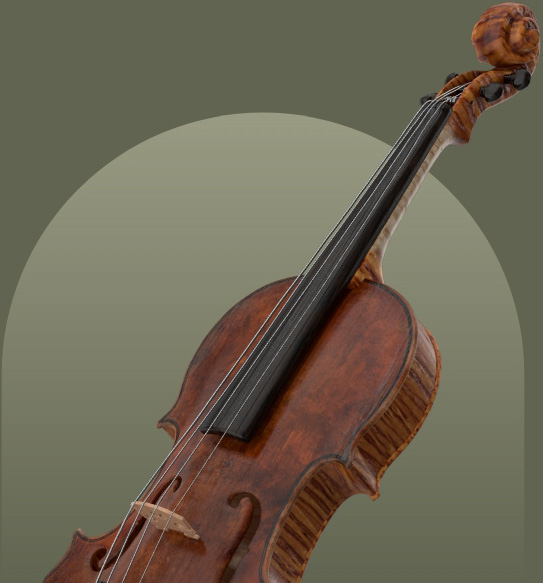
Daniel Parker
London, worked 1712–1720
Daniel Parker was a significant English violin maker active in London during the early 18th century, with his most productive period noted between 1720 and 1727. He is recognized as the first English maker to adopt the Stradivari model, though he also copied Stainer and N. Amati. His craftsmanship, while not always thoroughly finished, is described as fine and full of personality, characterized by a rich orange-red or deeper brown varnish and scrolls often featuring a blackened chamfer in the Stradivari manner. Sources conflict on his exact working dates and presumed teachers, with some suggesting B. Norman, Urquhart, or Pamphilon, while others argue he was a self-taught 'born artist.' Parker made instruments largely for the trade, often without his own label, and his violins were used by notable musicians like Fritz Kreisler. He is credited, alongside Benjamin Banks, with shifting the English preference away from the Stainer model.
Auction Price History
Highest auction price
13 results
| Type | Details | Auction house | Sold | Price |
|---|---|---|---|---|
| Violin | Lot 181 | Bonhams | March 2012 | £3,125 |
| Violin | 35.2 cm London, 1720 c. (head possibly later) | — | October 2011 | £9,375 |
| Violin | 35.8 cm London, 1715 c. | — | December 2010 | £5,760 |
| Violin | 36.0 cm London, 1715 c. | — | April 2008 | £9,400 |
| Violin | 35.6 cm London, Early 18th C. | — | October 2007 | £4,375 |
| Violin | 36.2 cm Attributed to | — | November 2006 | £8,160 |
| Violin | London, 1714 | — | May 2005 | £4,800 |
| Violin | 1720 c. | — | March 1995 | £3,220 |
| Violin | 1750 c. | — | April 1991 | £9,900 |
| Violin | 17-- | — | November 1990 | £5,280 |
| Violin | 1750 c. | — | November 1988 | £17,600 |
| Violin | 17-- | — | September 1982 | £2,530 |
| Violin | 1715 | — | January 1981 | £2,444 |
No results match those filters.
Maker Overview
Life
Daniel Parker (circa 1712-1720) was an outstanding English maker of the early 18th century, working in London, UK. He was the first English maker to adopt the Stradivari model.'s interest in the Stradivari model may have been sparked by the presence in London of the Cremonese violinist Gaspare Visconti, who was personally acquainted with Stradivari. Dilworth notes that no reliable record of Parker's circumstances has yet been found.
Characteristics
- Model
- Daniel Parker was the first English maker to adopt the Stradivari model, basing his work on a 'long pattern' model of circa 1690, though with rather full arching. William Meredith Morris adds that Parker copied (or tried to copy) Stainer, Stradivari, and N. Amati. Cecie Stainer notes that he improved the pattern of his instruments, making them more similar to those of Amati.
- Workmanship
- John Dilworth describes Parker's workmanship as 'not thoroughly well-finished, but is very fine and full of personality.' Cecie Stainer calls him a 'very clever workman.' William Meredith Morris characterizes it as 'free, firm, and rugged, with little or no feminine gracefulness smiling from its lines.' George Hart notes that Parker left his violins 'thick in wood.'
- Varnish
- Dilworth states the varnish is 'usually a rich orange-red or deeper brown and of good consistency and texture.' Stainer describes it as 'red varnish, a disagreeable colour, rather thickly laid on; the varnish rather transparent and soft.' Morris notes it is 'of excellent quality, tender, and of various reddish shades, sometimes a little thick and dull.' Hart describes it as 'of a mellow quality, and fairly transparent.' Willibald Leo Lütgendorff highlights his 'fine, beautiful, only sometimes too thick oil varnish of bright red color,' noting its suppleness.
- Scrolls
- Scrolls generally have a blackened chamfer in the manner of Stradivari. Morris mentions a 'rather doubtful scroll' on the 1712 instrument and a 'magnificent scroll' on the instrument owned by Clarkson Close.
- Wood
- The wood used was excellent, often handsomely figured.
- Tone
- Cecie Stainer describes the tone as 'clear and powerful.' William Meredith Morris states the tone of the Clarkson Close instrument is 'bright, clear, and powerful,' and that Parker's tone has 'much the same characteristics as that of Banks.'
- Instruments Produced
- Parker made almost exclusively violins. However, John Dilworth notes that 'at least one viola of eccentric form is known, with double-canted back and decorative purfling.'
- Daniel Parker
London 1717John Dilworth
Influence and legacy
- Mentorship: Daniel Parker is presumed by John Dilworth to have been a pupil of B. Norman. Cecie Stainer and Willibald Leo Lütgendorff suggest he was possibly a pupil of Urquhart or Pamphilon. However, William Meredith Morris disputes this, stating it is 'difficult to understand' on what ground this surmise is made, as there is 'not the remotest resemblance between his work and that of either of these.' Morris suggests it is 'not necessary to suppose that he was a pupil of anybody, for he was a born artist, and endowed with natural mechanical skill.'
- Employment: He was later employed by J. Hare, and several examples of his work have been found with Hare's label.
- Artistic Inspiration: His interest in the Stradivari model may have been sparked by the presence in London of the Cremonese violinist Gaspare Visconti, who was personally acquainted with Stradivari.
- Impact on English School: George Hart credits Parker, in conjunction with Benjamin Banks, with the merit of 'breaking through the prejudice so long in favour of preference for the Stainer model.'
- Notable Users: Fritz Kreisler used a Parker violin as his concert instrument.
- Market Presence: Parker made largely for the trade, and consequently, his instruments are often sold under other names. William Meredith Morris states that Parker 'did not worry about fame, and was content to dispose of his ware to the trade.'
- Historical Significance: His instruments are considered 'typical examples of British work of the classical period' by William Meredith Morris. George Hart notes that his instruments are 'well worthy of attention from those in search of good Violins at a moderate cost.'
Biographies
The overview above is drawn from the following published accounts. Read them in the original:
John Dilworth+
PARKER, Daniel Worked circa. 1712-1720 London UK. Outstanding English maker of the early 18th century and the first to take up the Stradivari model. Presumed to have been a pupil of B. Norman. Later employed by J. Hare: several examples of his work have been found with Hare’s label. No reliable record of his circumstances has yet been found. His interest in the Stradivari model may have been sparked by the presence in London in this period of the Cremonese violinist Gaspare Visconti who was personally acquainted with Stradivari. Parker’s work is based on a ‘long pattern’ model of c.1690, although with rather full arching. Workmanship is not thoroughly well-finished, but is very fine and full of personality. Varnish is usually a rich orange-red or deeper brown and of good consistency and texture. Scrolls generally have a blackened chamfer in the manner of Stardivari. Fritz Kreisler used a Parker as his concert instrument. At least one viola of eccentric form is known, with double-canted back and decorative purfling. Daniel Parker / London 1717 [BVMA]
Willibald Leo Lütgendorff+
Vielleicht ein Schüler von Urquhart oder Pamphilon. Er machte fast ausschliesslich
Violinen und kommt darin den Italienern sehr nahe. Namentlich
darf sein feiner, schöner, nur manchmal zu dicker Öllack von leuchtendrother
Farbe seiner Geschmeidigkeit wegen hervorgehoben werden.
George Hart+
This is another maker of the English school, who was possessed of exceptional talent, and whose instruments are well worthy of attention from those in search of good Violins at a moderate cost. To Parker belongs, in conjunction with Benjamin Banks, the merit of breaking through the prejudice so long in favour of preference for the Stainer model. The dates of his instruments extend from the year 1740 to 1785. He left his Violins thick in wood, which has certainly enhanced their value now that time has ripened them. He used excellent material, which is often very handsome. The varnish is of a mellow quality, and fairly transparent. A large number of these Violins have been passing under other makers’ names, and have been but little noticed.
William Meredith Morris+
The information which is usually given respecting this maker is mis- leading, and most writers content themselves with repeating early errors in almost the same words. Hart, Haweis, and Miss Stainer give his period as being 1740-85, and Fleming as 1715-85. As a matter of fact they are all wrong. There are- undoubtedly genuine examples of his work bearing the dates 1712, 1719, 1726, and 1732 still in existence. The earliest which I have seen is dated 1712, a specimen which has been pronounced genuine by the Messrs. Hart, and also by the Messrs. Hill. It is on the long Strad model, slightly modified, and with a rather doubtful scroll. Mr. Richard Hilton, of Derby House, Matlock Bridge, is the owner of this interesting instrument, and for the illustrations (see opposite) of this earliest known example of Parker I have to tender him my sincere thanks. It has been surmised that Parker was the pupil of Pamphilon, or of Urquhart, or of both, but on what ground it is difficult to understand, as there is not the remotest resemblance between his work and that of either of these. It is not necessary to suppose that he was a pupil of anybody, for he was a born artist, and endowed with natural mechanical skill. Given an artistic mind and an aptitude for tools, and a man may by hard work and perseverance develop into a first-class luthier without undergoing the usual routine of long apprenticeship. Parker’s instruments are typical examples of British work of the classical period. They embody the strong points of those who may be considered to be above him, as well as some of the weak points of those who were below him. He was a good maker, but only a moderately good copyist. His fiddles will never pass as Italians, because they are too thoroughly British in character. Strongly built, honest, and unpretending in demeanour, they should prove to be objects of uncommon interest to the connoisseur. Parker copied (or tried to copy) Stainer, Stradivari, and N. Amati. The workmanship is much the same throughout ; free, firm, and rugged, with little or no feminine gracefulness smiling from its lines. The varnish is of excellent quality, tender, and of various reddish shades, sometimes a little thick and dull. His tone has much the same characteristics as that of Banks. Comparatively few of this maker’s instruments bear his label. He was a man who lived in the future, and who sacrificed immediate reputation as much as the exigencies of time and tide would allow him. He evidently did not worry about fame, and was content to dispose of his ware to the trade. Had he worked his plates thinner, and thought it worth his while to copy the reigning god (Stainer) more closely, he doubtless would have attracted universal patronage. But Daniel was of a philosophical turn of mind, and gave to the world the milk of wisdom rather than the sweets of fancy. What is considered to be the finest Parker violin in existence is owned by Clarkson Close, Esq., of Dagmar Lodge, Leeds. This is also on the long Strad lines (see illustration), with red amber oil varnish, and a magnificent scroll.
This example is considered by the Messrs. Hill to belong to the year 1700, or thereabouts. I would urge that in point of detail and general effect it resembles much more the instruments made in 1726 than it does those made in 1712 and 1715. Parker made his best instruments from about 1720 to 1727. The tone of this instrument is bright, clear, and powerful.
Cecie Stainer+
A maker in London about 1714-85. He was a very clever workman, possibly a pupil of Urquhart or Pamphilon, but made a step in advance, improving the pattern of his instruments, making them more similar to those of Amati. He used red varnish, a disagreeable colour, rather thickly laid on ; the wood was excellent, often handsomely figured ; the varnish rather transparent and soft; the tone clear and powerful.
He made largely for the trade, consequently his instruments are often sold under other names ; no viola or violoncello of his has ever been seen, only violins are known. About 1793 they were valued at five guineas each ; about 1805 they realised as much as fifteen guineas each.
Sell your instrument with Amati
Get started by uploading photos of your instrument for our experts to review.
Sell your instrument with Amati
Get started by uploading photos of your instrument for our experts to review.