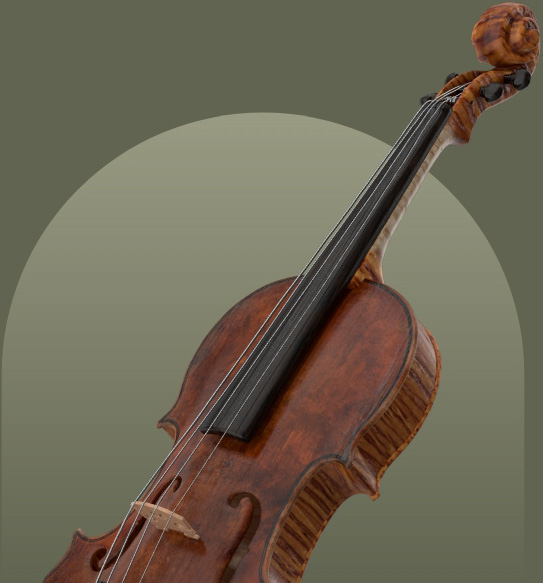
Gotha School
Franz Anton Ernst
Gotha, 1745–1805
Franz Anton Ernst was a celebrated violinist and concertmaster who, despite conflicting birth year accounts (1715 or 1745), died in Gotha in 1805. After a distinguished career as a musician, including studies in law and violin in Prague and service in Georgenthal and Gotha, he dedicated the last decade of his life to violin making. His instruments, crafted after the Stradivari model with flat arching, were known for their fine workmanship, excellent varnish, and a tone comparable to Cremonese instruments. Ernst even studied mathematics to refine his craft and published an article on violin construction. He was musically mentored by Antonio Lolli and influenced by Eberle in his instrument-making endeavors, also training apprentices such as J. A. Otto, Artmann, and Bindernagel. His violins were highly esteemed and used by figures like Spohr.
Maker Overview
Life
Franz Anton Ernst (Sources contain conflicting information about his birth year, either 1715 or 1745, died 1805) was born in Georgenthal, Bohemia. He pursued legal studies in Prague, while also diligently engaging in music, particularly violin playing. Ernst initially served as a syndic in Georgenthal before entering the service of Count Salm, where he fully developed his musical talents. He returned to Prague in 1773, achieving significant success as a musician. In 1778, he was appointed as a court musician and concertmaster in Gotha, a position that allowed him the leisure to dedicate himself to violin making, as detailed by George Hart and Cecie Stainer. During the last ten years of his life, Ernst ceased public performances to focus exclusively on instrument construction, a pursuit he had cultivated earlier out of artistic interest, possibly inspired by Eberle. He even undertook additional studies in mathematics to further perfect his violin-making craft.
Characteristics
- Model
- Franz Anton Ernst's instruments were crafted following the Stradivari model, a detail consistently noted by John Dilworth, Willibald Leo Lütgendorff, and Cecie Stainer.
- Workmanship
- His violins are described by John Dilworth as 'finely worked with very good quality varnish'. Willibald Leo Lütgendorff adds that they exhibit a 'flat arching' and were 'very highly praised'.
- Tone
- The tone of his instruments was highly regarded, with Cecie Stainer stating it 'almost equalled that of the Cremona instruments'.
- Technical Study
- To achieve greater perfection in violin making, Ernst undertook special instruction in mathematics.
- Publication
- In 1804, he published a significant article on the construction of violins in the Allgemeine Musikalische Zeitung in Leipzig.
Influence and legacy
- Musical Mentorship: As an eminent violinist, Franz Anton Ernst received lessons from Antonio Lolli.
- Inspiration: Willibald Leo Lütgendorff suggests that Ernst's interest in violin making may have been stimulated by Eberle.
- Apprentices: Ernst initially worked with J. A. Otto, who later became a prominent German maker. After Otto established his own business, Artmann and Bindernagel, both carpenters, left Weimar to become apprentices to Ernst.
- Reputation: His violins were highly praised, and the renowned violinist Spohr frequently used them in his concerts.
- Compositions: Ernst composed a considerable amount of music, though only a small portion of it was published.
Biographies
The overview above is drawn from the following published accounts. Read them in the original:
John Dilworth+
ERNST, Franz Anton Born 1745, died 1805 Gotha Germany. Celebrated violinist and concert master. Violin maker from 1785. Stradivari model. Finely worked with very good quality varnish.
George Hart+
He was an eminent Violinist, and received lessons from Antonio Lolli. In 1778 he was engaged as court musician at Gotha. He took great interest in Violin-making, and made several excellent instruments.
Cecie Stainer+
b. Dec. 3, 1715, at Georgenthal, in Bohemia , d. Jan 10. 1805, Gotha. Was a celebrated violinist, but also the maker of some very excellent instruments. His first work was done in Prague, where he went for purposes of study about 1763 ; but in 1778, being appointed sold violinist to the Court of Gotha, he there found leisure to devote himself to the making of violins. He had at first working with him J A. Otto, who later became one of the best German makers.
When Otto started his own business at Weimar, Artmann and Bindernagel, both carpenters, left Weimar and became apprenticed to Ernst. He followed the Stradivari model, and the tone of his instruments is said almost to have equalled that of the Cremona instruments. In 1804 he published in the Allgemeine Musikalische Zeitung (Leipzig) a very interesting article on the construction of violins.
Willibald Leo Lütgendorff+
In Prag beendete er das Studium der Rechtswissenschaft, betrieb aber dabei
eifrig Musik, besonders das Geigenspiel. Er wurde erst Syndikus in Georgenthal,
trat dann in die Dienste des Grafen Salm und bildete sich nunmehr vollkommen
zum Musiker aus. Als solcher kam er 1773 nach Prag zurück und
erzielte grosse Erfolge. 1778 wurde er als Concertmeister nach Gotha berufen.
In den letzten zehn Jahren seines Lebens trat er nicht mehr öffentlich auf,
sondern beschäftigte sich ausschliesslich mit dem Geigenbau, dem er sich, vielleicht durch Eberle angeregt, schon früher aus künstlerischem Interesse zugewendet
hatte; ja, er nahm jetzt noch besonderen Unterricht in der Mathematik,
um noch Vollendeteres im Geigenbau leisten zu können. Seine Geigen, die nach
Stradivarius gemacht sind, zeigen flache Wölbung und werden sehr gelobt, und
selbst Spohr benutzte sie gerne in seinen Concerten. — Er componirte sehr viel,
doch ist nur Weniges in Druck erschienen. Sein bester Schüler im Geigenbau
Sell your instrument with Amati
Get started by uploading photos of your instrument for our experts to review.
Sell your instrument with Amati
Get started by uploading photos of your instrument for our experts to review.