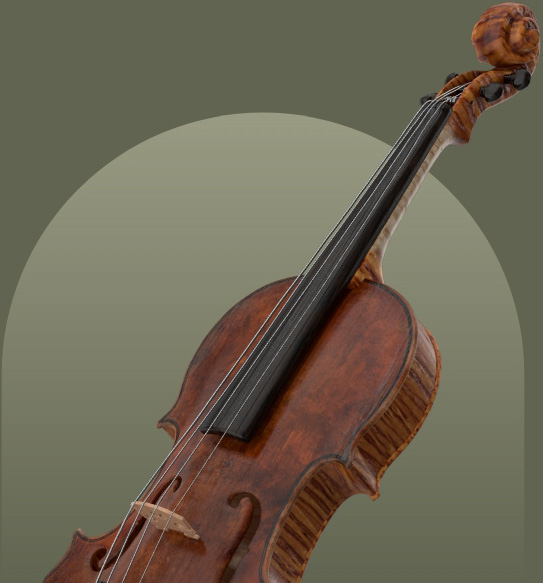
Francesco (I) Grancino
Milan, worked 1660–1670
Francesco (I) Grancino was a Milanese luthier, active within the renowned Grancino family workshop., he was the younger brother and assistant of Giovanni Grancino, working circa 1660-1670. However, other historical accounts, such as that by Cecie Stainer, describe a Francesco Grancino, identified as a son of Giovanni and grandson of Paolo, working later from 1700-1746 alongside a brother. His craftsmanship is noted for fine contralto violas, often compared to Andrea Guarneri's, and violins in the Amati style, characterized by a large volute and specific fluting. While some sources, like Stainer, describe the Grancino family's work as occasionally rough with plain wood, they consistently highlight the good tonal qualities of their instruments, particularly violoncellos and double basses.
Auction Price History
Highest auction price
4 results
| Type | Details | Auction house | Sold | Price |
|---|---|---|---|---|
| Cello | 76.0 cm Milan, Late 17th C. Possibly by | — | February 2007 | £88,800 |
| Violin | Milan, 1736 | — | October 2004 | £10,624 |
| Viola | 41.8 cm 1680 c. | — | November 2000 | £201,408 |
| Viola | 41.9 cm 1692 | — | March 1994 | £111,500 |
No results match those filters.
Maker Overview
Life
Francesco (I) Grancino (circa 1660-1670) worked in Milan, Italy. in The Brompton's Book of Violin & Bow Makers, he was the younger brother and assistant of Giovanni Grancino. His work is primarily known from instruments bearing the joint label of Francesco and Giovanni. A few violins are also ascribed to him alone, crafted in a fine Amati style.
Characteristics
- Contralto Violas
- Instruments bearing the joint label of Francesco and Giovanni are often fine contralto violas of excellent model, similar to those of Andrea Guarneri.
- Violins
- A few violins ascribed to Francesco (I) Grancino alone are of a fine Amati style.
- Volute
- Instruments feature a rather large volute, with the two central flutes merging at the front face in the manner of early Amati work.
- Corners
- The corners are prominent and outward-pointing.
- Gio e Francesco Grancino
in Contrada Largha di Milano, anno 16..John Dilworth - Gio e Francesco fratelli de Grancini
in Contrada larga di Milano, 16..John Dilworth - Fratelli Grancini in Contrada
larga di Milano al Segno della
Corona. 16..John Dilworth
Influence and legacy
- Mentorship: John Dilworth identifies Francesco (I) Grancino as the younger brother and assistant of Giovanni Grancino, indicating a direct working relationship and probable training under his elder sibling.
- Stylistic Influences: His work shows clear stylistic influences, with violas similar to those of Andrea Guarneri and violins crafted in a fine Amati style, including specific details like the volute and fluting reminiscent of early Amati work.
- Family Continuity: Francesco (I) Grancino was part of the prominent Grancino family of Milanese luthiers, which included his brother Giovanni and, according to some accounts, his father Giovanni and grandfather Paolo.
Biographies
The overview above is drawn from the following published accounts. Read them in the original:
John Dilworth+
GRANCINO, Francesco (I) Worked circa. 1660-1670 Milan Italy. Younger brother and assistant of Giovanni Grancino, below. His work is known mostly from instruments bearing the joint label of Francesco and Giovanni. Notably, these are often fine contralto violas of excellent model, similar to those of Andrea Guarneri. A few violins are ascribed to him alone, of fine Amati style. Rather large volute, the two central flutes merging at the front face in the manner of early Amati work. Prominent outward-pointing corners. Gio e Francesco Grancino / in Contrada Largha di Milano, anno 16.. Gio e Francesco fratelli de Grancini / in Contrada larga di Milano, 16.. Fratelli Grancini in Contrada / larga di Milano al Segno della / Corona. 16..
George Hart+
Here we have the same falling off as in the case of the Gagliani, a family beginning with artists and ending with common workmen.
Cecie Stainer+
Sons of Giovanni and grandsons of Paolo Grancino. Worked together at Milan, 1700-46. They were the best makers of this family and made a great many instruments, using yellowish colour, and wood of poor quality ; their work was rough, but the tone of their violoncellos and double-basses was fairly good.
A violoncello, of fine powerful tone, was made of plain wood, that of the belly only being fine ; the light yellow varnish had become darkened with age. Their instruments generally were not beautiful to look at, but had a good tone.
and ” (Giov. Battista e Francesco fra. Grancini in contrada largo di Milano, 17—.”
Sell your instrument with Amati
Get started by uploading photos of your instrument for our experts to review.
Sell your instrument with Amati
Get started by uploading photos of your instrument for our experts to review.