
Italy School
Pietro (I) Guarneri
Cremona, Mantua, 1655–1720
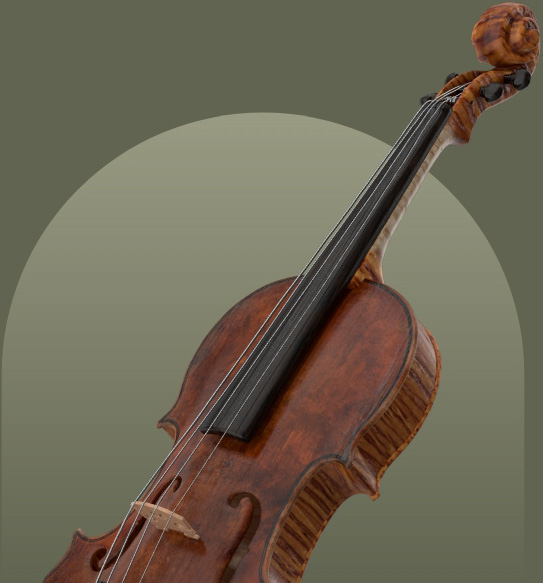
Pietro (I) Guarneri, born in Cremona in 1655, was the elder son and pupil of Andrea Guarneri. After an initial period in his father's workshop, he established himself in Mantua by 1683, where he developed a unique and disciplined style. His instruments are characterized by often high archings, elegant narrow soundholes, and a distinctive, heavy scroll. Renowned for his particularly fine, deep red-brown varnish, he is considered by many to be the best craftsman of the Guarneri family. Pietro (I) Guarneri played a pivotal role in founding the Mantuan school of violin making, significantly influencing later makers such as Camillo Camilli and Tomasso Balestrieri. Despite some structural choices, such as thin wood, that could affect tone, his instruments are highly valued for their originality and exceptional craftsmanship.
Auction price history
Highest auction price
| Type | Details | Sold | Price |
|---|---|---|---|
| Violin | 35.4 cm 1700 c. (upper bass rib and peg box replaced) | October 2007 | £85,672 |
| Violin | 35.5 cm Mantua, 1710 c. | October 2007 | £14,900 |
| Violin | 35.4 cm Mantua | February 2007 | £117,600 |
| Violin | 35.4 cm Mantua, 1715 | October 2006 | £225,971 |
| Violin | 35.5 cm The head by Giovanni Battista Ceruti [Attributed to] | May 2006 | £14,716 |
| Violin | 1700 c. | November 2003 | £162,000 |
| Violin | 1685 | June 2002 | £89,150 |
| Violin | 1680 (poor condition) | June 2001 | £40,150 |
| Violin | 1715 | June 1994 | £221,500 |
| Violin | 1703 | October 1993 | £80,700 |
| Violin | 1703 | November 1988 | £66,000 |
| Violin | 1707 | November 1986 | £88,000 |
| Violin | 1686 | November 1985 | £52,800 |
| Violin | 1707 | April 1985 | £108,000 |
| Violin | 1715 Mantua | April 1983 | £30,800 |
| Violin | 1704 Mantua | November 1981 | £30,800 |
Maker Overview
Life
Pietro (I) Guarneri (1655-1720) was born on February 18, 1655, in Cremona, Italy, and was the elder son and pupil of Andrea Guarneri. He was active and identifiable in the instruments of the Guarneri workshop from about 1670. Pietro (I) Guarneri left Cremona sometime after 1677, or according to other sources, remained until 1680. By 1683, he had settled in Mantua, where he worked both as a luthier and a musician in the ducal court. In 1677, he married Caterina Sussagni, and they had one son, Andrea Francesco, born on January 29, 1678, who did not become a violin maker. He visited Cremona for a few months in 1698, likely prompted by his father's terminal illness, and during this period, he worked for his brother Giuseppe. He then returned to Mantua and is believed to have lived there from 1700 to 1740. Sources contain conflicting information about his death date, with John Dilworth stating he died in 1720 in Mantua, while Cecie Stainer suggests he died around 1740. The notion that he eventually settled in Venice and fell into poverty is likely a confusion with his nephew, Pietro (II) Guarneri.
Characteristics
- Style
- His work developed a unique and very disciplined style, often influenced by Stainer in the very high archings.
- Soundholes
- He crafted elegant, narrow soundholes finished with large eyes at each terminus.
- Scroll
- The scroll is described as relatively heavy compared to the general delicacy of the rest of the work, featuring a large eye and strong chamfer. Other accounts describe it as very characteristic, broad, and possessing an original character.
- Varnish
- Pietro's varnish is considered particularly fine, even among his peers. John Dilworth describes it as deep red-brown, even, well-applied, virtually without textural flaws, and laid over a finely reflective golden ground. Cecie Stainer notes it as transparent, of beautiful rich quality, in either warm yellow or pale red. Willibald Leo Lütgendorff mentions excellent pale red or brown-yellow lacquer. Sources contain conflicting information regarding the transparency and application quality of his varnish.
- Originality
- His instruments differ significantly from those of his father and brother, showcasing great originality.
- Violins
- His violins are typically on a large pattern and are very arched. He used good wood, with the bellies often having a wide and very even grain. The breadth between the sound-holes is increased, and the corners are delicately worked.
- Purfling
- The purfling is described as excellent.
- Tone
- The tone of his violins is full but, lacks brilliancy. Willibald Leo Lütgendorff notes that while the tone is noble, it is often not very loud, possibly due to the arching being a little too high at the broad breast.
- Violoncellos
- The violoncellos he made in Mantua were often of exaggerated form, intended for use in processions where performers would suspend them around their necks.
- Experimental Forms
- He made attempts to find new forms, exemplified by a surviving viola from 1698 that lacks corners.
- F-holes & C-bouts
- The F-holes are broad and round, positioned midway between the styles of Amati and Stradivari, while the C-bouts are more reminiscent of Nicolo Amati.
- Workmanship
- His work is sometimes described as baroque and not always very precise.
- Defects
- Cecie Stainer notes some serious defects, including making the backs and bellies of his violins too thin. This resulted in a veiled and dull tone, excessive flexibility, difficulty in maintaining pitch, and a propensity for strings to break.
- Petrus Guarnerius Cremonensis filius Andreae / fecit Mantuae sub tit. Sanctae Teresiae 1685John Dilworth
Influence and legacy
- Mentorship: He was the pupil of his father, Andrea Guarneri. Sources contain conflicting information about whether he was also a pupil of Girolamo Amati; Cecie Stainer suggests this, but Willibald Leo Lütgendorff states he likely learned from his father.
- Stylistic Influence: His work was apparently influenced by Stainer, particularly in the often very high archings of his instruments.
- Mantuan School: Pietro (I) Guarneri was important in founding the small but significant Mantuan school of violin making.
- Influence on Others: He very strongly influenced two of the Mantuan school's most highly regarded makers, Camillo Camilli and Tomasso Balestrieri.
- Craftsmanship Recognition: Most consider him to have been the best craftsman of the Guarneri family.
- Instrument Value: His instruments are highly valued.
- Founding a School: He played a crucial role in establishing the Mantuan school of violin making.
Biographies
The overview above is drawn from the following published accounts. Read them in the original:
John Dilworth+
GUARNERI, Pietro (I) Born 1655 Cremona, died 1720 Mantua Italy. Elder son and pupil of Andrea Guarneri, above. Active and identifiable in the instruments of the Guarneri workshop from about 1670, he left sometime after 1677 and was settled in Mantua by 1683, working both as a luthier and musician in the ducal court. His work there developed a unique and very disciplined style, apparently influenced by Stainer in the often very high archings, and with elegant narrow soundholes finished with large eyes at each terminus. The scroll is relatively heavy compared with the general delicacy of the rest of the work, with a large eye and strong chamfer. Pietro’s varnish is particularly fine even amongst his peers. It is deep red-brown, even and well-applied, virtually without textural flaws, and laid over a finely reflective golden ground. Most consider him to have been the best craftsman of the Guarneri family. He was important in founding the small but significant Mantuan school, and both its most highly regarded makers, Camillo Camilli and Tomasso Balestrieri, were very strongly influenced by him. Petrus Guarnerius Cremonensis filius Andreae / fecit Mantuae sub tit. Sanctae Teresiae 1685
George Hart+
Son of Giuseppe filius Andrea. He followed to some extent the form of the instruments of his uncle Pietro, from whom, while in Mantua, he probably learnt his art. The work is very good, and his productions are well worthy of the Guarnerian name. The varnish is rich, but not so transparent nor so well laid on as to come up to the full standard. The scroll is rather weak.
Cecie Stainer+
Eldest son of Andrea, b. Feb. 18, 1655, at Cremona; d. about 1740. He remained in Cremona till 1680, then went to Mantua; he visited Cremona for a few months in 1698 (the year of his father’s death), but returned to Mantua and probably lived there, 1700-40. Said to have been a pupil of Girolamo Amati.
His instruments differ from those of his father and brother, but he used their labels for the violins made before he had left Cremona. His work shows great originality; his violins are on a large pattern, very arched, made of good wood, that of the bellies being wide in grain and very even; the breadth between the sound-holes is increased and the corners are delicately worked; the purfling excellent; the scroll very characteristic; the transparent varnish, of beautiful rich quality, either warm yellow or pale red colour ; the tone is full, but lacks brilliancy.
The violoncellos he made when in Mantua are often of exaggerated form, and were intended for use in processions, the performers having them suspended round the neck.
His work, generally excellent, had some serious defects. Though quite correctly making the backs and bellies of his violins of equal thicknesses, he made them too thin, which rendered the tone veiled and dull, and also gave too much flexibility to the instrument, so that the tension on the strings is great, it is difficult to keep them up to pitch, and they are liable to break. His instruments, however, are much valued.
Labels: “Petrus Guarnerius Cremonensis fecit Mantuai sub. tit. Sanctae Teresiae, 1695,” similar ones are dated 1690 and 1710;
and ” Revisto e corretto da me Pietro Guarneri Cremonese in Mantova, 1697.”
In 1677 he married Caterina Sussagni; had one son, Andrea Francesco, b. Jan. 29, 1678, who was not a violin maker.
Willibald Leo Lütgendorff+
Erstgeborner Sohn von Andrea G., bei dem er bis 1680 blieb, nachdem er
sich schon 1677 mit Caterina Sussagni verheirathet hatte. Später liess er sich
in Mantua nieder und kam nur noch einmal im Jahre 1698 nach Cremona
zurück, wahrscheinlich veranlasst durch die schwere, mit dem Tode endigende
Krankheit seines Vaters. In dieser Zeit arbeitete er für seinen Bruder Giuseppe.
Dass er zuletzt in Venedig ansässig gewesen und dort ganz herunter gekommen
sein soll, beruht wohl auf einer Verwechslung mit seinem Neffen Pietro (II.).
Man wollte ihn früher für einen Amati-Schüler halten, doch hat er wahrscheinlich
bei seinem Vater gelernt. Er war ein sehr begabter Geigenmacher, aber
ein etwas unruhiger Geist, was ihn verhindert haben mag, voll auszureifen. In
der Form weichen seine Geigen bedeutend von denen seines Vaters und Bruders
ab, ja er machte sogar Versuche, neue Formen zu finden, wofür eine noch erhaltene
Alt-Viola von 1698 spricht, bei der er die Ecken weggelassen hat, also
dasselbe that, was später u. A. Chanot gethan hat, der eine ganz neue Erfindung
damit gemacht zu haben glaubte. Sonst ist sein Modell sehr schön und gross,
die F-Löcher sind breit und rund und halten die Mitte zwischen Amati und
Stradivari, während die )( mehr an Nic. Amati erinnern; die Schnecke ist breit
und hat einen originellen Zug, und die Einlagen sind sehr schön. Die Wölbung
nahm er bei breiter Brust ein wenig zu hoch, wesshalb auch der Ton seiner
Geigen, so edel er an sich genannt werden muss, oft nicht allzu gross ist. Das Holz
ist in der Regel sehr schön und der blassrothe oder braungelbe Lack vortrefflich.
Seine Arbeit ist manchmal barock und nicht immer sehr genau, und wenn
dies bei ihm die Schönheit des Tons nicht beeinträchtigt, so scheinen die Recht
zu haben, die behaupten, dass es doch ein Geheimniss der Cremoneser gab, von
dem eben der Ton abhängig war. Eine aus Venedig datirte Violine von ihm
sah der Geigenmacher Methfessel vor einigen Jahren in Wien.
Sell your instrument with Amati
Get started by uploading photos of your instrument for our experts to review.
Sell your instrument with Amati
Get started by uploading photos of your instrument for our experts to review.
Working in Cremona at the same time
Aegidius Barzellini worked 1670–1720
Alberta Giordani worked 1710–1748
Andrea Guarneri 1623–1698
Antonio Stradivari 1644–1737
Antonio Zanotti (Zanoti) worked 1706–1745
Bartolomeo Giuseppe Guarneri 1698–1744
Carlo (I) Bergonzi 1683–1747
Carlo Rugeri 1666–1713