
Marseille School
Antoine Marius Richelme
Marseille, 1833–1896
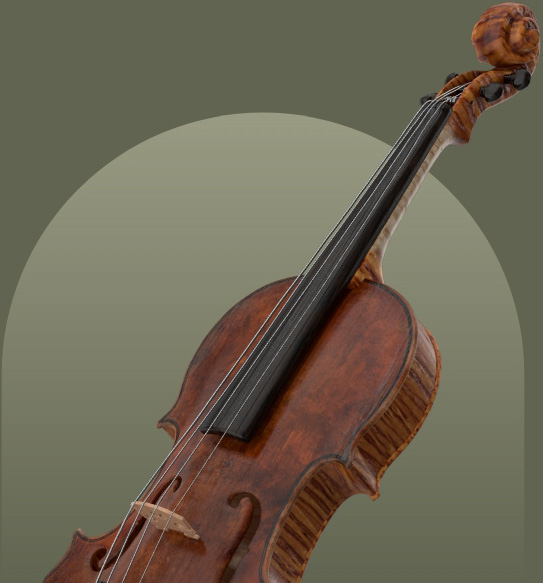
Antoine Marius RICHELME (1833-1896) was a French luthier from Marseille, a pupil of Yong, who established his independent workshop in 1867. He is known for developing the 'Modèle Richelme' from 1883, which adapted the viol form to the violin, often featuring carved heads and incorporating theoretical acoustical ideas. His early work followed classical models, and he published significant treatises on lutherie, including Études et observations sur la lutherie ancienne et moderne (1868) and Renaissance du Violon et de ses Analogues (1873). A Stradivari model violin by Richelme is preserved in the Marseilles Museum.
Auction price history
Highest auction price
| Type | Details | Sold | Price |
|---|---|---|---|
| Viola | Bearing the maker's label, back decoration, double purfling, in excellent and playing condition | June 2024 | £2,534 |
| Violin | 37.3 cm Marseille, 1874 | December 2010 | £673 |
| Violin | 37.0 cm Marseille, 1885 c. | June 2008 | £836 |
| Viola | 42.0 cm Marseille, 1885 | June 2007 | £962 |
| Viola | 37.0 cm Marseille, 1874 | June 2004 | £118 |
| Violin | 1894 | December 2002 | £1,816 |
| Violin | 1890 | June 2000 | £218 |
| Violin | 1892 | November 1981 | £770 |
Maker Overview
Life
Antoine Marius RICHELME (1833-1896) was born in 1833 and died in 1896 in Marseille, France. He was a pupil of Yong in Marseille in 1850. Subsequently, he worked for Luppi-Coviaux, manufacturers of tailpieces and chinrests, etc., and also for Coviaux Sippy and Daniel. Richelme established himself independently in 1867. His early work was finely achieved and based on classical models. Later, from 1883, he developed his own 'Modèle Richelme', which was essentially a viol form adapted to the violin, applying the theoretical acoustical ideas of Savart. These models often featured carved heads in place of scrolls, though they did not sustain their initial success. A Stradivari model violin by Richelme, featuring picturesque carving on the back and gold leaf on the edges, is preserved in the Marseilles Museum. He was the author of Études et observations sur la lutherie ancienne et moderne (Marseille, 1868) and Renaissance du Violon et de ses Analogues (Marseille, 1873).
Characteristics
- Early Work
- His early work was finely achieved and based on classical models.
- Modèle Richelme
- From 1883, he developed his 'Modèle Richelme', which adapted the viol form to the violin, incorporating the theoretical acoustical ideas of Savart. These instruments often featured carved heads instead of scrolls.
- Design Philosophy
- Cecie Stainer notes that he greatly modified the curves of the upper and lower bouts of his instruments, almost returning to the ancient viol-shape. Willibald Leo Lütgendorff adds that he believed the salvation of his art lay in returning to the old viol form, and his viol-form instruments are characterized by a full sound.
- Workmanship
- Henri Poidras observed that while the pattern of his instruments was not always pleasing, the work was good, and the heads were often carved or ornamented.
- Specific Instrument
- A Stradivari model violin by Richelme, with picturesque carving on the back and gold leaf on the edges, is preserved in the Marseilles Museum.
- Fait par Marius Richelme
Auteur et observations sur la
lutherie ancienne et moderne
No. 10..John Dilworth - S.C.P. compositionJohn Dilworth
Influence and legacy
- Teacher: He was a pupil of Yong in Marseille in 1850.
- Early Employment: He worked for Luppi-Coviaux, manufacturers of tailpieces and chinrests, etc., and also for Coviaux Sippy and Daniel respectively.
- Successor: Willibald Leo Lütgendorff identifies Diter as his successor.
- Museum Preservation: A Stradivari model violin by Richelme is preserved in the Marseilles Museum.
Biographies
The overview above is drawn from the following published accounts. Read them in the original:
John Dilworth+
RICHELME, Antoine Marius Born 1833, died 1896 Marseille France. Pupil of Yong in Marseille 1850. Subsequently worked for Luppi-Coviaux, manufacturers of tailpieces and chinrests, etc. Established independently 1867. Early work is finely achieved and based on classical models. Later, from 1883, developed his own ‘Modèle Richelme’ which was essentially a viol form adapted to the violin applying the theoretical acoustical ideas of Savart. Most have carved heads in place of scrolls. These have not sustained their initial success. Author of Études et observations sur la lutherie ancienne et moderne’(Marseille, 1868) and Renaissance du Violon et de ses Analogues (Marseille, 1873). Stradivari model violin, with picturesque carving on the back and gold leaf on the edges, preserved in the Marseilles Museum. Latin motto applied to the ribs: ‘Humanas voce meis in fibris quatuor invenies’. Inscribed internally: ‘Fait à Marseille 1886, Richelme’. Fait par Marius Richelme / Auteur et observations sur la / lutherie ancienne et moderne / No. 10.. S.C.P. composition
Cecie Stainer+
A maker in Marseilles, who greatly modified the curves of the upper and lower bouts of his instruments, almost returning to the ancient viol-shape. He published in Marseilles, 1868 : ” Etudes et observations sur la lutherie ancienne et moderne.”
Willibald Leo Lütgendorff+
Schüler von Yong in Marseille; arbeitete bei Coviaux Sippy und Daniel und machte sich 1867 selbstständig. Ein talentvoller Geigenmacher, der das Heil seiner Kunst darin erblickte, dass man zur alten Violenform zurückkehre. Er machte verschiedene Geigen und Bratschen nach diesen Principien, die sich durch vollen Klang auszeichnen, und gab 1868 eine Schrift unter dem Titel: »Etudes et observations sur la lutherie ancienne et moderne« heraus. Sein Nachfolger wurde Diter.
Henri Poidras+
The pattern is not pleasing but the work is good and the heads often carved, or ornamented.
Sell your instrument with Amati
Get started by uploading photos of your instrument for our experts to review.
Sell your instrument with Amati
Get started by uploading photos of your instrument for our experts to review.
Working in Marseille at the same time
Francois Malakoff Brugere 1822–1875
Justin Victor Diter 1866–1941