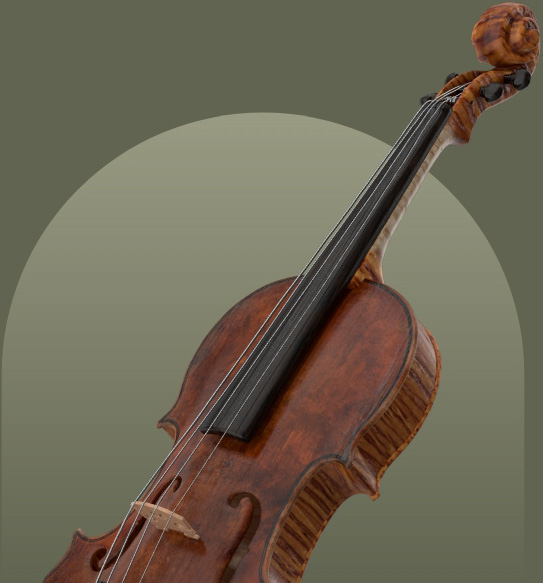
Michael Angelo Bergonzi
Cremona, 1721–1758
Michael Angelo Bergonzi, son of the renowned Carlo Bergonzi, was a Cremonese luthier active from around 1740 to 1765, though sources conflict on his exact birth and death dates. He moved into the Casa Stradivari in 1745 and succeeded his father in 1747. While his general workmanship was considered inferior to his father's, his instruments are noted for their interesting qualities and a strong affinity to the late work of Guarneri del Gesù, bridging the Stradivari and Guarneri traditions. He worked with varied patterns, including a preference for the broad Stradivari model, and his varnish ranged from pale golden yellow to hard and thick. Although the tone of his string instruments was often described as nasal, his double-basses were highly regarded for their powerful sound. He also focused on making mandolins, making his string instruments relatively rare.
Auction Price History
Highest auction price
| Type | Details | Auction house | Sold | Price |
|---|---|---|---|---|
| Violin | 1750 c. | — | March 1996 | £74,100 |
No results match those filters.
Maker Overview
Life
Michael Angelo Bergonzi (1721-1758), also known as Michel Angelo Bergonzi, was born in Cremona, Italy. in The Brompton's Book of Violin & Bow Makers, he was born in 1721 and died in 1758. However, Cecie Stainer in A Dictionary of Violin Makers states he was born in 1722 and died after 1765. He was the eldest son of Carlo Bergonzi (I).
Characteristics
- Workmanship
- Although inferior in workmanship to the instruments of his father, Carlo Bergonzi, Michael Angelo Bergonzi's work is considered very interesting and important by John Dilworth. Cecie Stainer describes his work as heavy and altogether inferior to Carlo's. Willibald Leo Lütgendorff states his work is quite good, but he never reached his father's level.
- Models
- He worked after various models, but preferred the broad Stradivari pattern. Cecie Stainer notes that he flattened the model and exaggerated the curves, following both small and large patterns. George Hart also observed that the pattern of his instruments was somewhat varied, with many being large and others under-sized.
- Wood
- Willibald Leo Lütgendorff mentions that his wood is beautiful.
- Varnish
- His varnish is described as a pale golden yellow by John Dilworth. Willibald Leo Lütgendorff characterizes his varnish as "stumpf" (dull). Cecie Stainer states the varnish is hard and thick, while George Hart notes it is hard and distinct from that associated with Cremonese instruments.
- Tone
- The tone of his instruments is frequently described as "näselnd" (nasal) by Willibald Leo Lütgendorff and Cecie Stainer. However, his double-basses are noted for showing better work and having a powerful tone, serving well in an orchestra.
- Specialization
- Willibald Leo Lütgendorff indicates that he focused particularly on the construction of mandolins and similar instruments early on, making string instruments from him relatively rare.
- Michel Angelo Bergonzi
figlio di Carlo
fece in Cremona l’anno 1746John Dilworth
Influence and legacy
- Family Tradition: As the eldest son of Carlo Bergonzi (I), he continued the family's lutherie tradition in Cremona.
- Artistic Affinity: His work shows a particularly strong affinity to the late work of Guarneri del Gesù, who died in 1744. John Dilworth notes that his violins symbolically and actually drew the two great houses of Stradivari and Guarneri together in the last days of the classical era of Cremonese lutherie.
- Family: Willibald Leo Lütgendorff states that Michael Angelo Bergonzi had three sons.
Biographies
The overview above is drawn from the following published accounts. Read them in the original:
John Dilworth+
BERGONZI, Michel Angelo Born 1721, died 1758 Cremona Italy. Eldest son of Carlo Bergonzi (I), above. Moved with his family into the Casa Stradivari in 1745. His earliest identifiable work is dated 1744. Although inferior in workmanship to the instruments of his father, Michael Angelo’s work is very interesting and important. It shows a particularly strong affinity to the late work of Guarneri del Gesù, who died in 1744. Symbolically and in actuality his violins finally draw the two great houses of Stradivari and Guarneri together in the last days of the classical era of Cremonese luthierie. Michael Angelo died very young, and his work did not develop satisfactorily. Indeed, the last instruments are very weak, with a pale golden yellow varnish. Michel Angelo Bergonzi / figlio di Carlo / fece in Cremona l’anno 1746 [Gindin]
George Hart+
Son of Carlo. The pattern of his instruments is somewhat varied. Many are large and others under-sized. The varnish is hard, and distinct from that associated with Cremonese instruments.
Cecie Stainer+
Son of Carlo, b. 1722; d. after 1765. Worked in Cremona about 1740-65. His work is heavy and altogether inferior to that of Carlo, he flattened the model and exaggerated the curves; followed both small and large patterns ; the varnish is hard and thick, the tone is nasal. But his double-basses show better work and have a powerful tone, serving well in an orchestra.
Another is known, dated 1755.
Willibald Leo Lütgendorff+
Sohn von Carlo B., dessen Nachfolger er 1747 wurde. Wenn er auch nach
verschiedenen Modellen arbeitete, so bevorzugte er doch das breite Stradivari-
Patron. In der Arbeit ist er recht gut, auch sein Holz ist schön; seinen Vater
erreichte er aber doch niemals. Sein Lack ist stumpf und der Ton häufig
näselnd, vorzüglich dagegen sind seine Bässe. Da er sich frühzeitig besonders
auf den Bau von Mandolinen etc. verlegte, kommen Streichinstrumente von ihm
verhältnissmässig selten vor. — Er hatte drei Söhne.
Sell your instrument with Amati
Get started by uploading photos of your instrument for our experts to review.
Sell your instrument with Amati
Get started by uploading photos of your instrument for our experts to review.