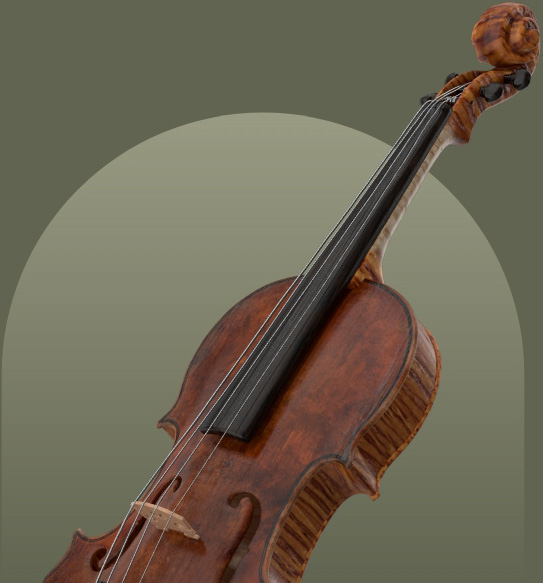
Milan School
Paolo Grancino
Milan, worked 1640–1690
Paolo Grancino was a violin maker active in Milan, Italy, from the mid to late 17th century. He is frequently cited as a pupil of Nicolò Amati, though this claim lacks definitive historical evidence according to some sources. Grancino's early work showed strong imitation of Amati, but he later developed a more distinctive style, particularly evident in his unique, elongated scrolls. He often used plainer woods, including poplar, for his instruments, which featured a good yellow or golden-yellow varnish. While his general workmanship was considered moderately good, his violas and violoncellos are highly regarded, with his best violoncellos noted for surpassing Amati's in tone volume and richness. His instruments are represented in the Museum Kraus in Florence, and his son, Giovanni, continued the family's violin-making tradition.
Maker Overview
Life
Paolo Grancino worked in Milan, Italy, with various sources indicating his active period as circa 1640-1690 or 1665-90., he emerged from Nicolò Amati's school and never disavowed his master throughout his life. George Hart also states that Paolo Grancino was a pupil of Niccolo Amati, and that the Grancino family, as violin makers, began with him, occupying a similar position to the Gagliani in following the Amati pattern. Cecie Stainer likewise identifies him as a pupil of Nicola Amati at Cremona. However, John Dilworth notes that, according to the Hills in their book on the Guarneri family, Grancino was a pupil of Nicolò Amati, but no evidence has so far been discovered to confirm this, or even the existence of Paolo Grancino. Hart observes a gradual development of ideas in Grancino's instruments, indicating a true artist. His early works bore the stamp of a mere copyist, but later, his own artistic dictates became more apparent, though never to the extent of innovators like Stradivari, Bergonzi, and Guarneri.
Characteristics
- Authenticity
- Instruments are found with his label, but their authenticity is difficult to determine.
- Workmanship
- Willibald Leo Lütgendorff states that Grancino freed himself from the "slavish imitation" of his master very late, which likely led to many of his best works being fitted with Amati labels by dealers. Cecie Stainer describes his work as generally "but moderately good," noting that the scroll was often roughly cut, and the purfling and corners carelessly worked.
- Scroll
- His work can be easily recognized by the "original longer scroll,". George Hart further describes the scroll of Paolo Grancino as having a "very decisive character," quite distinct from that of the Amatis, with the turn rapidly made from the ear of the scroll, giving it an "elongated appearance."
- Wood
- His wood was "not always beautiful," and he sometimes used poplar wood for the back and sides. George Hart notes that the wood he used was varied but "for the most part, plain." Cecie Stainer also states he "used poor material, often making the back and sides of poplar tree wood." Hart contrasts this with Venice, where the handsomest wood was used, suggesting that Milan and Naples used plainer materials.
- Varnish
- Willibald Leo Lütgendorff describes his yellow varnish as "quite good." Cecie Stainer characterizes it as a "dry varnish of an effective golden-yellow colour."
- Pattern
- Cecie Stainer indicates he "followed a large pattern, slightly arched, with large sound-holes widely opened."
- Instruments
- His violas and violoncellos are particularly fine instruments. Willibald Leo Lütgendorff states that he "almost always surpasses Amati" in his violas. George Hart notes that his best violoncellos "surpass those of Amati in volume of tone, and the quality is often very rich." Cecie Stainer also mentions that his altos and violoncellos are generally liked.
Influence and legacy
- Mentorship: Paolo Grancino is widely considered a pupil of Nicolò Amati, and Cecie Stainer. However, John Dilworth points out that "no evidence has so far been discovered to confirm this."
- School/Tradition: The Grancino family, beginning with Paolo, followed the Amati pattern, similar to how the Gagliani imitated Stradivari.
- Museum Holdings: Works by Paolo Grancino are held by the Museum Kraus in Florence.
- Family Continuity: His son, Giovanni Grancino, also became a violin maker.
Biographies
The overview above is drawn from the following published accounts. Read them in the original:
John Dilworth+
GRANCINO, Paolo Worked circa. 1640-1690 Milan Italy. According to the Hills in their book on the Guarneri family he was a pupil of Nicolò Amati, but no evidence has so far been discovered to confirm this, or even the existence of Paolo Grancino. Instruments are found with his label, but authenticity is hard to determine.
George Hart+
Pupil of Niccolo Amati. The Grancino family, as makers of Violins, commence with this maker, and occupy a similar position, as followers of the Amati pattern, to that of the Gagliani as imitators of Stradivari. Paolo Grancino was pupil of Niccolo Amati. There is noticeable in his instruments that gradual development of ideas which is always associated with the true artist. His early works bear the stamp of the mere copyist; later on the borrowed plumes are less apparent, the dictates of his own fancy are discoverable, but never to such an extent as to permit him to be classed with Stradivari, Bergonzi, and Guarneri, as striking out into entirely untrodden paths. His Violoncellos are particularly fine instruments; his Violas also are worthy of notice. The wood he used was varied, but is, for the most part, plain. It is curious to observe how various centres of Violinmaking ran upon different qualities of wood. In Venice the handsomest wood was used, in Milan and Naples the plainest. The commercial importance of Venice would, of course, draw to it the largest selection of wood, and thus permit the second and third-rate makers to use it, and at the same rate, probably, that a less handsome material would cost the makers of cities further off. The scroll of Paolo Grancino has a very decisive character; it is quite distinct from that of the Amatis. From the ear of the scroll the turn is rapidly made, and has an elongated appearance. His best Violoncellos surpass those of Amati in volume of tone, and the quality is often very rich.
Cecie Stainer+
Worked at Milan, 1665-90. Pupil of Nicola Amati at Cremona. He made a large number of instruments; the altos and the violoncellos are generally liked. He used poor material, often making the back and sides of poplar tree wood ; followed a large pattern, slightly arched, with large sound-holes widely opened, and a dry varnish of an effective golden-yellow colour. The scroll was often roughly cut, and the purfling and corners carelessly worked. His work on the whole was but moderately good. His son, Giovanni, was also a maker.
Willibald Leo Lütgendorff+
Aus Nicola Amati’s Schule hervorgegangen, die er sein Leben lang nicht
verleugnete. Von der sklavischen Nachahmung seines Meisters befreite er sich
erst sehr spät, wesshalb sicher eine grosse Zahl seiner besten Arbeiten von
Händlern mit Amatizetteln versehen worden ist. An der originellen längeren
Schnecke kann seine Arbeit übrigens leicht erkannt werden. Sein Holz ist nicht
immer schön, manchmal nimmt er zu Boden und Zargen nur Pappelholz, dagegen
ist sein gelber Lack recht gut. In seinen Bratschen übertrifft er Amati fast
immer. Arbeiten von ihm besitzt das Museum Kraus in Florenz.
Sell your instrument with Amati
Get started by uploading photos of your instrument for our experts to review.
Sell your instrument with Amati
Get started by uploading photos of your instrument for our experts to review.