
Germany School
Georg Aman
Augsburg, Vils, 1671–1731
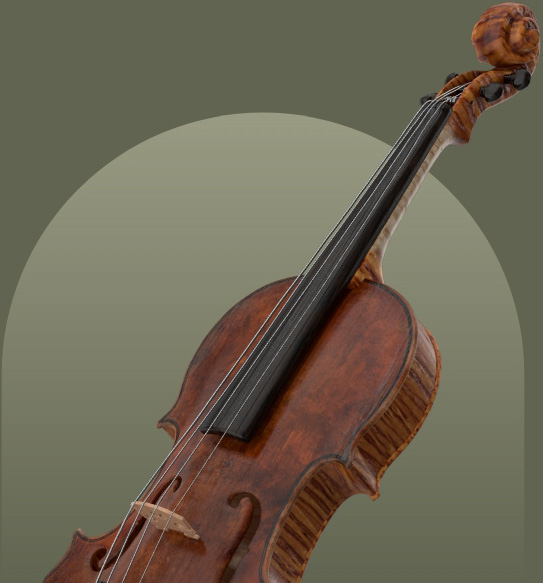
Georg Aman was an 18th-century lutenist and violin maker from Vils, Bavaria, who worked in Augsburg, Germany. Known for his Stainer-model instruments, he often incorporated carved heads on pegboxes and used carefully selected woods, frequently with one-piece backs and pearwood for necks and scrolls. While sources offer conflicting descriptions of his varnish, his larger instruments are generally considered his finest work. Several of his instruments, including a Poche, lute, violin, and Altquinton, are preserved in various European museums and collections.
Auction price history
Highest auction price
| Type | Details | Sold | Price |
|---|---|---|---|
| Violin | Augsburg, 1723 | November 2005 | £2,526 |
| Violin | 1720 | June 2001 | £8,400 |
| Viola | 41.9 cm 1698 | November 1980 | £2,750 |
Maker Overview
Life
Georg Aman (1671-1731) was born in 1671 in Vils, Bavaria, and died in 1731 in Augsburg, Germany, according to The Brompton's Book of Violin & Bow Makers by John Dilworth. He married the widow of the lutenist M. Wöhrlein (Wörle) on February 13, 1695, as recorded in the Augsburg marriage register. He was still mentioned in the Augsburg tax records of 1717.
Characteristics
- Model
- Aman often followed a Stainer model, but he also varied his models frequently.
- Features
- His instruments sometimes featured painted purfling. He was fond of adding carved heads to the pegboxes of his instruments.
- Materials
- The wood for his instruments was often selected with care, with the back typically made from a single piece. The neck and scroll were frequently crafted from pearwood.
- Varnish
- Sources contain conflicting information regarding his varnish. John Dilworth describes it as "extraordinary varnish of thick texture and good red-orange colour." In contrast, Willibald Leo Lütgendorff states that his varnish "does not particularly stand out" and ranges in color from "light red to dark brown."
- Sound Quality
- His work is generally considered good, though his violins are noted as not having a "great tone." His larger instruments, such as violas, cellos, and basses, are considered his best.
- Georg Aman
Lauten
– und Geigen-Macher
in Augsburg, 1724John Dilworth
Influence and legacy
- Museum Holdings: A Poche (pocket violin) from 1699 is held in the Germanic Museum in Nuremberg. A small lute from 1707 is part of the princely Hohenzollern Museum in Sigmaringen. The State Collection of Patriotic Antiquities in Stuttgart possesses a violin from 1716. An Altquinton from 1729 (No. 875) is housed in the Royal Collection of Old Musical Instruments in Berlin.
- Exhibitions: A Pochette made by Aman was featured in the Vienna Music and Theatre Exhibition.
Biographies
The overview above is drawn from the following published accounts. Read them in the original:
John Dilworth+
AMAN, Georg Born 1671 Vils, Bavaria, died 1731 Augsburg Germany. Stainer model, sometimes with painted purfling. Rather ordinary work but blessed with extraordinary varnish of thick texture and good red-orange colour. Example dated 1724 illustrated in Hamma (1986). Georg Aman / Lauten / – und Geigen-Macher / in Augsburg, 1724
Willibald Leo Lütgendorff+
Er stammte aus Vils und heirathete nach dem Hochzeitsamtsprotokoll vom
13. Febr. 1695 die Wittwe des Lautenmachers M. Wöhrlein (Wörle). Im
Augsburger Steuerbuche von 1717 wird er noch genannt. Da man jedoch
Geigen von ihm kennt, die die Jahreszahlen 1678— 1729 tragen, lässt sich die
Zeit seines Wirkens um fast 30 Jahre verlängern. Seine Arbeit ist gut, er
wechselt jedoch die Modelle mehrfach und bringt am Wirbelkasten gern geschnitzte
Köpfchen an. Das Holz ist oft mit Sorgfalt ausgewählt, der Boden
meist aus einem Stück und Hals und Schnecke aus Birnbaumholz. Sein Lack,
der sich nicht gerade auszeichnet, ist von hellrother bis dunkelbrauner Farbe.
Seine Violinen haben keinen grossen Ton, am besten sind seine grossen Geigen
( Violen, Violoncelli und Bässe). Eine aus dem Jahre 1699 stammende Poche besitzt
das germanische Museum in Nürnberg, eine kleine Laute von 1707 das fürstl.
Hohenzollernsche Museum in Sigmaringen, eine Violine von 1716 die Staatssammlung
vaterl. Alterthümer in Stuttgart und ein Altquinton von 1729 die kgl.
Sammlung alter Musikinstrumente in Berlin (No. 875) etc. In der Wiener Musiku. Th.-Ausstellung war er mit einer Pochette vertreten. Er schreibt seinen Namen stets Aman (nicht Amann, aber auch nicht Amma).
Sell your instrument with Amati
Get started by uploading photos of your instrument for our experts to review.
Sell your instrument with Amati
Get started by uploading photos of your instrument for our experts to review.
Pupils
Matthias Aman Pupil
Family
Matthias Aman Son
Working in Augsburg at the same time
(Betz) Franz Petz 1702–1772
Anton Rief (Ruef) 1694–1786
Franz Betz 1702–1772
Georg Ferdinand Wenger 1680–1757
Hans Georg Edlinger b. 1666
Johann Uldarichus Eberle 1699–1768
Mathias Fichtl worked 1716–1724
Matthias Aman worked 1720–1765