
Augsburg School
Georg Ferdinand Wenger
Augsburg, c.1680–1757
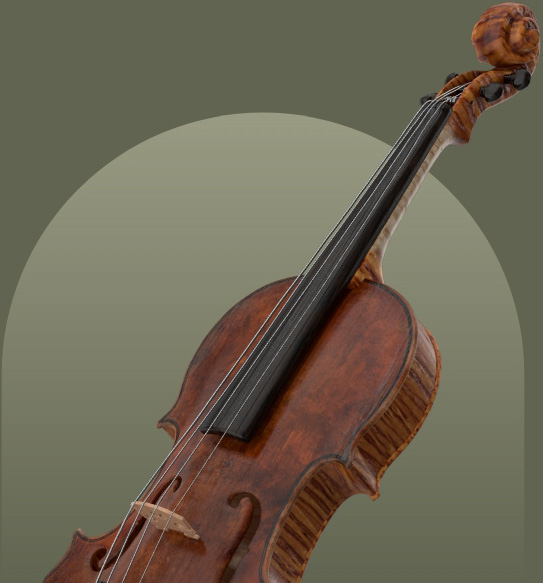
Georg Ferdinand Wenger, born around 1680 in Vienna and deceased in 1757 in Augsburg, was a prominent luthier active in Augsburg from 1701, following his marriage to the widow of Jakob Fichtl. He is recognized as one of the finest masters of the Augsburg school, known for instruments that recall the models of Stainer and Albani, yet possess original outlines. His craftsmanship is characterized by a full-arched Tyrolean model, narrow edges, deep hollowing, broadly cut soundholes, and often features carved animal or human heads instead of traditional scrolls. Wenger utilized well-chosen wood, frequently cut on the slab for backs, and applied varnish ranging from light red to dark brown. While his violas and cellos are particularly esteemed for their tone, he also produced violins, lutes, theorbs, and zithers. His instruments are preserved in significant collections, including the Nationalmuseum in München and the Germanisches Museum in Nürnberg.
Auction price history
Highest auction price
| Type | Details | Sold | Price |
|---|---|---|---|
| Violin | 35.1 cm Augsburg, 1730 c. | October 2009 | £816 |
| Cello | 1756 1/2 Size | October 2005 | £917 |
| Violin | 1739 | March 1995 | £3,680 |
Maker Overview
Life
Georg Ferdinand WENGER (c. 1680-1757) was born around 1680 in Vienna, Austria, and died in 1757 in Augsburg, Germany. He became active in Augsburg from 1701, the year he married the widow of the Augsburg lutenist Jakob Fichtl. While it is not ascertainable if he learned or worked in Vienna, the claim that he lived in Salzburg, as often asserted, appears entirely impossible, as no work from him dated from there has ever surfaced. He is considered one of the best masters of the Augsburg school., he was a maker in Augsburg about 1750-60, using labels such as "Gregorius Ferdinand Wenger Lauten und Geigenmacher fecit Augustae, 1750". John Dilworth notes that labels with posthumous dates are known, presumably finished by assistants. Another label example provided by Dilworth is "Gregori Ferdinand Wenger / Lauten- und Geigen-macher, / fecit Augustae 1732".
Characteristics
- Model
- His model recalls that of Stainer and Albani, yet it is original in its outlines and details. John Dilworth describes it as a full-arched Tyrolean model.
- Purfling and Edges
- The inlays are set 3 ½ mm from the edge, and the edge is narrow.
- Arching and Hollowing
- The hollowing is deep, and the arching is quite high.
- Soundholes
- The soundholes are broadly cut.
- Scroll
- The scroll is small and features an elongated pegbox, very much in the Albani manner. Frequently, carved angel or animal heads (such as lions or bears) are found instead of traditional scrolls.
- Wood
- The wood is well-chosen, with the back usually cut on the slab.
- Varnish
- The varnish varies from light red to dark brown. Henri Poidras notes it as light or dark red varnish. John Dilworth describes it as light gold to dark brown, fairly insubstantial but transparent.
- Dimensions
- The dimensions were shared by Piegendorfer.
- Best Instruments
- His violas and cellos are considered his best instruments in terms of tone.
- Other Instruments
- He also made many lutes, theorbs, and zithers, in addition to violins, violas, and cellos.
- Gregori Ferdinand Wenger
Lauten- und Geigen-macher,
fecit Augustae 1732John Dilworth
Influence and legacy
- Stylistic Influences: His manner and model recall that of Stainer and Albani, with his scroll particularly noted as being in the Albani manner.
- School: He is considered one of the best masters of the Augsburg school.
- Museum Holdings: Works by Georg Ferdinand Wenger are held in several notable institutions, including the Nationalmuseum in München, the Germanisches Museum in Nürnberg (which possesses a violin from 1754), and the Berlin Snoeck collection (which includes a zither from 1750).
Biographies
The overview above is drawn from the following published accounts. Read them in the original:
John Dilworth+
WENGER, Georg Ferdinand Born circa. 1680 Vienna Austria, died 1757 Augsburg Germany. Active in Augsburg from 1701, when he married the widow of J. Fichtl. One of the better makers of the Augburg school. Full-arched Tyrolean model. Narrow edge and purfling. Broadly cut soundholes. Scroll very much in the Albani manner. Light gold to dark brown varnish, fairly insubstantial but transparent. Carved animal or human heads frequently encountered. Also violas, cellos and various plucked instruments recorded. Labels with posthumous dates known, presumably finished by assistants. Gregori Ferdinand Wenger / Lauten- und Geigen-macher, / fecit Augustae 1732
Cecie Stainer+
A maker in Augsburg about 1750-60. Label: “Gregorius Ferdinand Wenger Lauten und Geigenmacher fecit Augustae, 1750”
Willibald Leo Lütgendorff+
Er stammte aus Wien und heirathete am 23. Oct. 1701 die Wittwe des Augsburger Lautenmachers Jakob Fichtl. Ob er in Wien gelernt oder gearbeitet hat, lässt sich nicht feststellen; dass er aber in Salzburg gelebt habe, wie so oft behauptet wird, erscheint ganz ausgeschlossen, da noch nie eine Arbeit von ihm, die von dort aus datirt wäre, zum Vorschein kam. Er gehört zu den besten Augsburger Meistern; sein Modell erinnert an Stainer und Albani, ist aber originell in den Umrissen und den Einzelheiten. Die Halbkreislinien sind beim Hals und beim Klotz gerade abgeplattet, die Einlagen sind 3 ½ mm vom Rand abstehend, die Hohlkehle ist tief und die Wölbung ziemlich hoch, das Holz ist gut gewählt, der Boden meist nach der Schwarte geschnitten, der Lack wechselt ab von hellrother bis dunkelbrauner Farbe. Die Schnecke ist klein und hat einen gestreckten Wirbelkasten, doch finden sich hier häufig Engels- oder Thierköpfchen (Löwen, Bären etc.). Die Maasse theilt Piegendorfer mit. Im Ton sind seine Violen und Violoncelli am besten. Arbeiten von ihm besitzen u. A. das Nationalmuseum in München, das Germanische Museum in Nürnberg (Violine von 1754), Berlin aus der Sammlung Snoeck (Zither von 1750), Paul de Wit’ etc. Er machte auch viele Lauten und Theorben.
Henri Poidras+
Augsburg circa 1735. His manner recalls that of Albani. Light or dark red varnish.
Sell your instrument with Amati
Get started by uploading photos of your instrument for our experts to review.
Sell your instrument with Amati
Get started by uploading photos of your instrument for our experts to review.
Working in Augsburg at the same time
Georg Aman 1671–1731
Hans Georg Edlinger b. 1666
Johann Elemann worked 1752–1763
Joseph Hiebler worked 1740–1792
Mathias Fichtl worked 1716–1724
Matthias Aman worked 1720–1765
Thomas (III) Edlinger 1662–1729