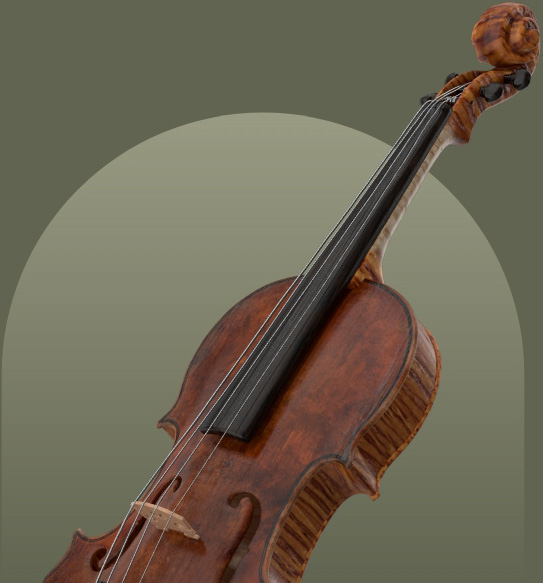
Naples School
Gennaro Gagliano
Naples, worked 1730–1780
Gennaro Gagliano, a highly regarded violin maker from Naples and the second son of Alessandro Gagliano, was known for his versatile craftsmanship. He primarily followed Amati and Stradivari models, with distinctive features such as the use of maple for purfling and specific arching and sound-hole designs. His instruments are noted for their beautiful wood and excellent orange-yellow or reddish varnish. Despite some uncertainties regarding his working years and the rarity of his labels, his work is considered of high quality, and he is often ranked among the best of the Gagliano family. The attribution of a significant violoncello to him highlights his potential to be counted among the front rank of great Italian makers.
Auction price history
Highest auction price
41 results
| Type | Details | Auction house | Sold | Price |
|---|---|---|---|---|
| Violin | Labelled Januarius Gaglianus Fecit Neapoli 1745 Lot 131 | Tarisio | March 2025 | £227,848est. $ 250,000-400,000 |
| Violin | Labelled Januarius Gagliano Filius Alexandri fecit Neap 1749 Lot 82 | Ingles & H. | March 2025 | £42,000est. £ 65,000-85,000 |
| Violin | Labelled Januarius Gaglianus Fecit Neap: 1749 Lot 145 | Tarisio | May 2024 | £122,506est. $ 50,000-80,000 |
| Violin | Labelled Januarius Gaglianus, Fecit Neapoli, 1743 Lot 61 | Tarisio | March 2024 | £94,400est. £ 80,000-120,000 |
| Cello | 75.7 cm Naples , 18th C. Attributed to | — | October 2011 | £61,250 |
| Violin | 35.6 cm 1770 c. Possibly by | — | October 2011 | £2,400 |
| Violin | 35.4 cm Naples, 1760 c. | — | October 2010 | £48,340 |
| Violin | 35.4 cm Naples, 1755 c. | — | April 2010 | £23,015 |
| Violin | 35.6 cm Naples, 1770 c. | — | March 2010 | £109,250 |
| Violin | 35.6 cm 1770 c. Possibly by | — | March 2010 | £5,400 |
| Violin | 35.5 cm Naples, 1760 c. Probably by | — | October 2009 | £39,650 |
| Violin | 35.6 cm Possibly by | — | October 2009 | £4,200 |
| Violin | 75.3 cm Naples, 1765 c. | — | April 2009 | £245,528 |
| Violin | 35.5 cm Naples, 1750 c. | — | March 2009 | £133,250 |
| Cello | 74.9 cm Naples, 1770 c. | — | October 2008 | £85,250 |
| Violin | 35.1 cm Naples, 1765 | — | October 2008 | £73,250 |
| Violin | 35.7 cm Naples, 1766 c. | — | October 2007 | £41,408 |
| Violin | 35.8 cm Ascribed to | — | October 2007 | £11,875 |
| Violin | 35.4 cm Naples, 1750 c. | — | November 2006 | £108,264 |
| Violin | Naples, 1770 c. Attributed to | — | November 2004 | £21,600 |
| Violin | Naples, 1763 | — | November 2004 | £78,000 |
| Violin | 1785 29.6 cm | — | November 2002 | £16,730 |
| Violin | 1730 | — | October 2002 | £89,720 |
| Cello | 1741 | — | November 1999 | £220,000 |
| Violin | 1756 | — | November 1996 | £74,750 |
| Violin | 1755 | — | December 1995 | £48,616 |
| Violin | 1750 c. | — | November 1993 | £35,200 |
| Violin | 17-- | — | November 1992 | £24,200 |
| Violin | 1750 | — | March 1992 | £27,500 |
| Violin | 1772 | — | November 1991 | £39,600 |
| Violin | 1750 c. | — | March 1991 | £20,900 |
| Violin | 1763 | — | June 1990 | £33,000 |
| Violin | 1749 | — | June 1988 | £15,400 |
| Violin | 1782 | — | March 1988 | £26,000 |
| Cello | 1750 c. | — | June 1987 | £38,500 |
| Violin | 1765 | — | November 1985 | £21,600 |
| Violin | 1760 c. | — | November 1984 | £18,700 |
| Cello | 1726 | — | April 1983 | £62,700 |
| Violin | 1786 | — | April 1983 | £7,260 |
| Violin | 1780 | — | March 1982 | £11,000 |
| Violin | 1750 | — | May 1980 | £9,680 |
No results match those filters.
Maker Overview
Life
Gennaro Gagliano, the second son of Alessandro Gagliano and brother of Nicola Gagliano, was a prominent Neapolitan violin maker. in The Brompton’s Book of Violin & Bow Makers, he worked approximately between 1730 and 1780 in Naples, Italy. However, Cecie Stainer in A Dictionary of Violin Makers states he was born about 1680 in Naples and died in 1750. Willibald Leo Lütgendorff notes that his best period was between 1730 and 1750. Lütgendorff also describes him as a pupil of his father, Alessandro Gagliano, whose influence on his work is unmistakable. John Dilworth considers him possibly the best and certainly the most versatile craftsman of the Gagliano family, a sentiment, who also describes him as the family's finest maker.
Characteristics
- Innovation
- Gennaro Gagliano employed specific personal techniques, such as using maple for the purfling rather than beech, a departure from most of his family's practice. He also made distinct modifications to the Stradivari model, sometimes making the arching higher and the sound-holes wider and steeper than the original Stradivari model. Cecie Stainer further describes his sound-holes as shorter and wider compared to his father's or Stradivari's.
- Materials
- He meticulously selected wood, which Willibald Leo Lütgendorff described as beautiful and Cecie Stainer noted as carefully chosen.
- Methods
- His craftsmanship involved utilizing numerous patterns, primarily based on Amati and Stradivari precedents, and his instruments are characterized by accurate finishing and perfectly realised archings, as detailed by John Dilworth. Cecie Stainer explains that he adapted the Stradivari pattern, drawing on his father's general outline and thicknesses. His varnish w as being of excellent quality and sometimes deeply coloured. Cecie Stainer noted its beautiful yellow, while Willibald Leo Lütgendorff characterized it as magnificent orange-yellow/reddish. Cecie Stainer adds that a varnish recipe in his handwriting remained in the family, though its secrets were not successfully passed on to successors.
- Frequently found with an additional label fixed to the upper rib containing a dedication: In conceptione tua Virgo Maria Immaculata fuisti
Ora pro nobis Patrem, cujus Filium Jesu de Sp. s peperisti’ Printed label: Januarius Gaglianus alumnus
Antonii Stradiuarii fecit Neapoli Ao 1770John Dilworth - Januarius Gagliano fecit
Neapoli anno Domini 1736John Dilworth - Gennaro Gagliano fecit Neap. 17..John Dilworth
- Januarius Gagliano filius
Alexandri. Fecit Neap. 17..John Dilworth
Influence and legacy
- Training and Mentorship: Gennaro Gagliano was the pupil of his father, Alessandro Gagliano, whose influence on his work is unmistakable.
- Schools/Tradition: His work demonstrates adherence to the Gagliano family tradition and a strong influence from the Stradivari model.
- Famous Owners: A magnificent violoncello, often attributed to Gennaro Gagliano despite bearing an Antonio Stradivari, 1732 label, has a documented history. It was purchased directly from Gennaro Gagliano around 1740 by an Italian, and later sold in 1765 to M. Champsor, a prominent violoncellist in Marseilles, before passing to M. Bonnet in 1826.
- Modern Recognition: Cecie Stainer notes that if the attribution of the 1732 "Stradivari" violoncello to Gennaro Gagliano could be proven, it would place him immediately in the front rank of great Italian makers. Willibald Leo Lütgendorff suggests that Gennaro Gagliano's quality equals or even surpasses that of his brother Nicola Gagliano.
Biographies
The overview above is drawn from the following published accounts. Read them in the original:
John Dilworth+
GAGLIANO, Gennaro Worked circa. 1730-1780 Naples Italy. Second son of Alessandro Gagliano, above. Possibly the best, certainly the most versatile, craftsman of the family. Used many patterns, mostly based on Amati and Stradivari precedents, accurately finished and with perfectly realised archings. An Amati copy once owned by Tarisio is said to have been made originally with an imitation Amati label; the fact that much of Gennaro’s work is unlabelled today implies that he may have been in the habit of using facsimile labels himself. Varnish of excellent quality, sometimes deeply coloured, but lacking the complexity and texture of Alessandro’s. Unlike most of the family, he used maple rather than beech for the purfling. Frequently found with an additional label fixed to the upper rib containing a dedication: In conceptione tua Virgo Maria Immaculata fuisti / Ora pro nobis Patrem, cujus Filium Jesu de Sp. s peperisti’ Printed label: Januarius Gaglianus alumnus / Antonii Stradiuarii fecit Neapoli Ao 1770 Januarius Gagliano fecit / Neapoli anno Domini 1736 Gennaro Gagliano fecit Neap. 17.. Januarius Gagliano filius / Alexandri. Fecit Neap. 17..
George Hart+
Januarius Gagliano, filius Alexandri fecit Neap, 1732.
Cecie Stainer+
Second son of Alessandro, brother of Nicola, b. about 1680, at Naples; d. 1750. He was the best maker of this family. He made few instruments, but put excellent work into them ; the pattern is good, slightly arched. He imitated his father in general outline and in thicknesses, was therefore really following the Stradivari pattern, but the sound-holes are shorter and wider. The wood was carefully selected, and the yellow varnish is beautiful, the quality of tone very fine ; his successors never succeeded in producing varnish equally beautiful, although a recipe in Gennaro’s own handwriting remained in the family ; he either purposely kept secret some essential ingredient, or forgot to make it known.
A magnificent violoncello, of perfect workmanship, dated Antonio Stradivari, 1732, is generally supposed to be Gennaro’s work ; the back and belly are more arched, the sides lower, the warm red-brown varnish darker and thicker than in Stradivari’s instruments. It was bought from Gennaro himself, about 1740, by an Italian, who sold it in 1765 to M. Champsor, a well known violoncellist in Marseilles ; on his death, in 1826, it passed from an amateur into the keeping of M. Bonnet, so that its tradition remains unbroken. If it could be proved that Gennaro made it, it would place him at once in the front rank of the great Italian makers. He seldom used labels for his instruments, and very often omitted to date them, so that it is not known exactly how many years he worked; but in 1730 his work was already excellent, and it steadily improved.
and “Januarius Gagliano filius Alexandri, fecit Neap., 1732 ” ; another similar one is dated 1741.
He sometimes pencilled his name on the inside of the belly.
Willibald Leo Lütgendorff+
Zweiter Sohn und Schüler seines Vaters Alessandro G., dessen Einfluss in
seiner Arbeit unverkennbar ist. Er ahmt das Stradivari-Modell nach, nur nimmt
er die Wölbung manchmal höher und macht auch die F-Löcher weiter und
steiler als sein Vorbild Seine beste Zeit ist zwischen 1730 und 1750; da er
jedoch nur selten Zettel eingeklebt hat und noch seltener die Jahreszahl ausfüllte,
ist das Alter seiner Geigen nicht immer leicht zu bestimmen, ja, man hat wegen des seltenen Vorkommens seiner Zettel gewiss mit Unrecht angenommen
dass er nur sehr wenig gearbeitet habe. Was man von ihm kennt, ist trefflich,
schönes Holz, prachtvoller orangegelber oder röthlicher Lack und herrlicher
Ton. Ein Cello von ihm ist jetzt wenigstens 4000 M. werth, eine aus dem
Jahre 1758 stammende Violine von ihm verkaufte Ch. Mahillon um 10 000 Frcs.
Gennaro G. kommt seinem Bruder Nicola G. vollkommen gleich, übertrifft ihn
Sell your instrument with Amati
Get started by uploading photos of your instrument for our experts to review.
Sell your instrument with Amati
Get started by uploading photos of your instrument for our experts to review.